




News & Articles
Browse all content by date.
 Duluth Herald, Nov. 29, 1916
Duluth Herald
Nov. 26, 1888
A YEAR’S RECORD.
The Official Figures of the
Minnesota Iron Company Show
Astonishing Growth.
“The growth of the iron mining industry and the development of the rich ranges in the “Vermillion District,” so called lying north and tributary to Duluth has been so rapid and so tremendous as to be almost beyond belief. Indeed nowhere but in the energetic heart of the rushing west could such a transformation take place as has been the result of the discovery of iron at Lake Vermillion. Late in August, 1884, the Duluth & Iron Range railroad was completed to the newly opened mines and the first cargo of ore shipped out. The season of 1888 has just closed and a total of 1,492,491 gross, or 1,679,031 net, tons of ore of the highest grade have been sent forward from the mines since their opening. Nowhere can such a record be found. No other mining company in the world, operating several pits on the same body or ore, has ever sent such a vast quantity of the highest priced ore to market in its first four years of development.
Until the present season only the mines at Tower were opened for mining, though for a couple of years it had been known that the richest part of the range was to the easterly. In the past August, however, a date almost identical with the first shipment from Tower, four year before, the Chandler mine, twenty-one miles east, sent its first cargo to market. Since then this single mine has sent forward 47,565 gross tons of a superb quality of ore.
 Duluth Herald, Nov. 29, 1916
Duluth Herald
Nov. 27, 1896
FELL OFF THE DOCK.
John Schelin Wants $25,000
For Doing It.
John Schelin fell of the ore dock at Two Harbors last summer, and he now wants $25,000 from the Duluth Iron Range road for going through that performance. His suit was filed in the United States circuit court this morning. He alleges that in June, 1896, he was working for the railroad in the Two Harbors ore dock. In the course of his duties he was compelled to climb into an ore pocket so as to arrange for the proper adjustment of the spout through which the ore goes into the boats. He was crossing the pocket on a plank provided for the purpose. The plank turned and he fell fifty feet off the dock, and finally brought up on the deck of a whaleback, insensible, bruised and seriously injured. He claims he will never be able to do manual labor again, and wants $25,000 to compensate himself for that.
 Duluth Herald, Nov. 30, 1926
Duluth Herald
Nov. 28, 1906
LID RESOLUTION IS LAID
ON TABLE BY ALDERMEN
Motion to Rigidly Enforce
Liquor Law Is Sidetracked.
No lid will adorn the Zenith City for the present at least.
By a vote of 10 to 6, the council last evening tabled the whole matter indefinitely and until it is taken from the table or brought up in some new form, no more will be heard about the agitation.
The matter was brought to a head when Alderman McEwen moved to table the motion of alderman Moore, which called upon the mayor to strictly enforce the liquor laws of the city. Alderman McEwen’s motion caried.
The council chamber and the upper corridor of the city hall were packed with supporters of both sides of the agitation, and it was a noisy, demonstrative crowd, the speeches being freely applauded and frequent interruptions being made.
Mayor Cullum, as was expected, submitted his communication explaining his position, and justifying his past record on the saloon question.
Hi communication went into the lid question very fully, but those who hoped to hear the mayor assail his opponent of a week ago and answer the charges made by A. R. Merritt that he was a liar and a murderer, were disappointed, as the mayor, in his communication, made no reference, at least directly, to Mr. Merritt.
 Duluth Herald, Dec. 1, 1936
Duluth Herald
Nov. 29, 1916
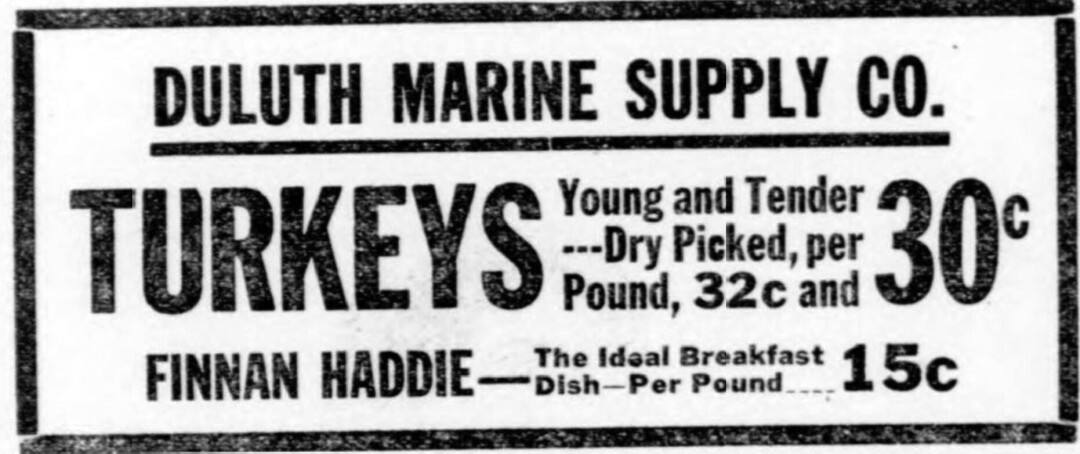
CONSUMERS’ LEAGUE MIGHT CHECK SOARING FOOD PRICES
Housewives’ League Has the Necessary Machinery; Mayor Prince Approves the Plan.
Why not a Consumers’’ League for Duluth?
Why not let the consumers join hands and say what they will pay for food products, instead of letting the dealers, or producers, or speculators dictate what they shall pay?
In Pittsburgh today the boycott on turkeys brought the price tumbling from 35 to 40 cents a pound down to about 18 cents.
Why couldn’t other prices be brought down in the same way?
The Housewives’ league has the necessary machinery at hand. Why could it not appoint a maximum price committee? This committee could fix the maximum price which consumers should pay for any product. When the price went over this figure, a boycott on that particular product would automatically take effect. The Herald would gladly publish these maximum prices and do all in its power to gain a following for the league.
As an example of how it could work: Let the committee fix a maximum price that would be paid for butter. When the price was over the figure, the league members would refuse to buy butter, using either oleomargarine or doing without butter until the price fell.
The efficiency of the league would depend entirely in the loyalty of the members. If such a league could have from 2,000 to 3,0000 loyal members who would absolutely observe its rules, it could work havoc with food speculators.
Mayor Approves It.
Mayor Prince declared himself in favor of the plan and offered to aid in the organization of such a body.
“I don’t think there is a corner, or any great speculation, in foodstuffs here,” said Mayor Prince, “but the organization of this league will mean that the dealers will be unable to go above a fair maximum fixed on all household necessities.
“Such a league is feasible and will mean much to the people of Duluth. If the dealers go above the maximum, the consumers could cease to purchase that commodity, replacing it with something else.
“The city officials will do everything in their power to help the consumers of the city.
Ask Mayor’s Advice.
Yesterday afternoon Mrs. J. T. Watson, president of the Duluth branch of the National Housewives’ league, and Mrs. W. C. Sherwood, called on Mayor Prince and asked him what steps should be taken to stop the continued increase in prices of foodstuffs. He directed them to obtain legal advice relative to making a Federal grand jury investigation.
Many organizations have prepared interesting reports on present food conditions, one inf particular showing that food prices have increased 24 percent from 1907 to 1915, and that wages increased but 12 percent.
 Duluth Herald, Dec. 2, 1946
Duluth Herald
Nov. 30, 1926
WILL INSIST ON
BOTTLE RETURN
Milk Dealers of City Will Complete
Organization Plans.
In their fight against an annual loss of $36,000, resulting from the wasteful practices of milk consumers with regard to milk bottles, the milk dealers of Duluth tomorrow are going to follow the old “eye for an eye” principle and demand an empty bottle for a full one. Up until the present the dealers have been lax in insisting on return of the “empties,” and at some households milk is left each day but no bottle is ever set out for return. The dealers assert that they are not at fault in demanding return of the containers, as if they insist on getting their bottles back the householder immediately transfers his business to another dairyman.
Tonight the dealers will meet at the city hall to complete the forming of the Duluth Milk Dealers’ association, and one of the things they will go on record for is immediate return of each bottle or its value in cash. As more than 95 per cent of the local dealers are member, it will do the consumer little good to threaten to trade elsewhere, said G. H. Davis, a dairy expert representing the 500 Dairy Products company here.
Many Bottles Destroyed.
“Pleas for co-operation have done little good,” said Mr. Davis. “For years dealers have begged their consumers to return bottles immediately, but in spite of this the destruction of bottles is enormous and very costly to the dairyman.
“A local dairyman went out Saturday with a wagon and in a short time collected 1,000 bottles that had been left at rooming houses. In another place, a consumer had stacked the ’empties’ up on his garage floor until there was scarcely from for the car to enter.
“Thousands of bottles are thrown into the city dumps each month. Each bottle costs from 5 to 8 cents. One large dairy firm buys $1,500 worth of bottles each month to replace the wastage.
“Duluth is very backward in this respect, probably because the milk dealers have not been organized and able to assert themselves. In all other cities dealers insist on a return of the containers,” said Mr. Davis.
In their insistence that consumers will co-operate with them, the dealers will invoke the recent city ordinance, No. 3074, which decrees that milk bottles cannot be used for anything but milk products, and that the consumer must wash the containers and place them were they can be picked up by the deliveryman.
The dealers tonight will choose their officers to operate the association, and tomorrow morning the rule for the return of bottles will be strictly enforced.
 Duluth Herald
Dec. 1, 1936
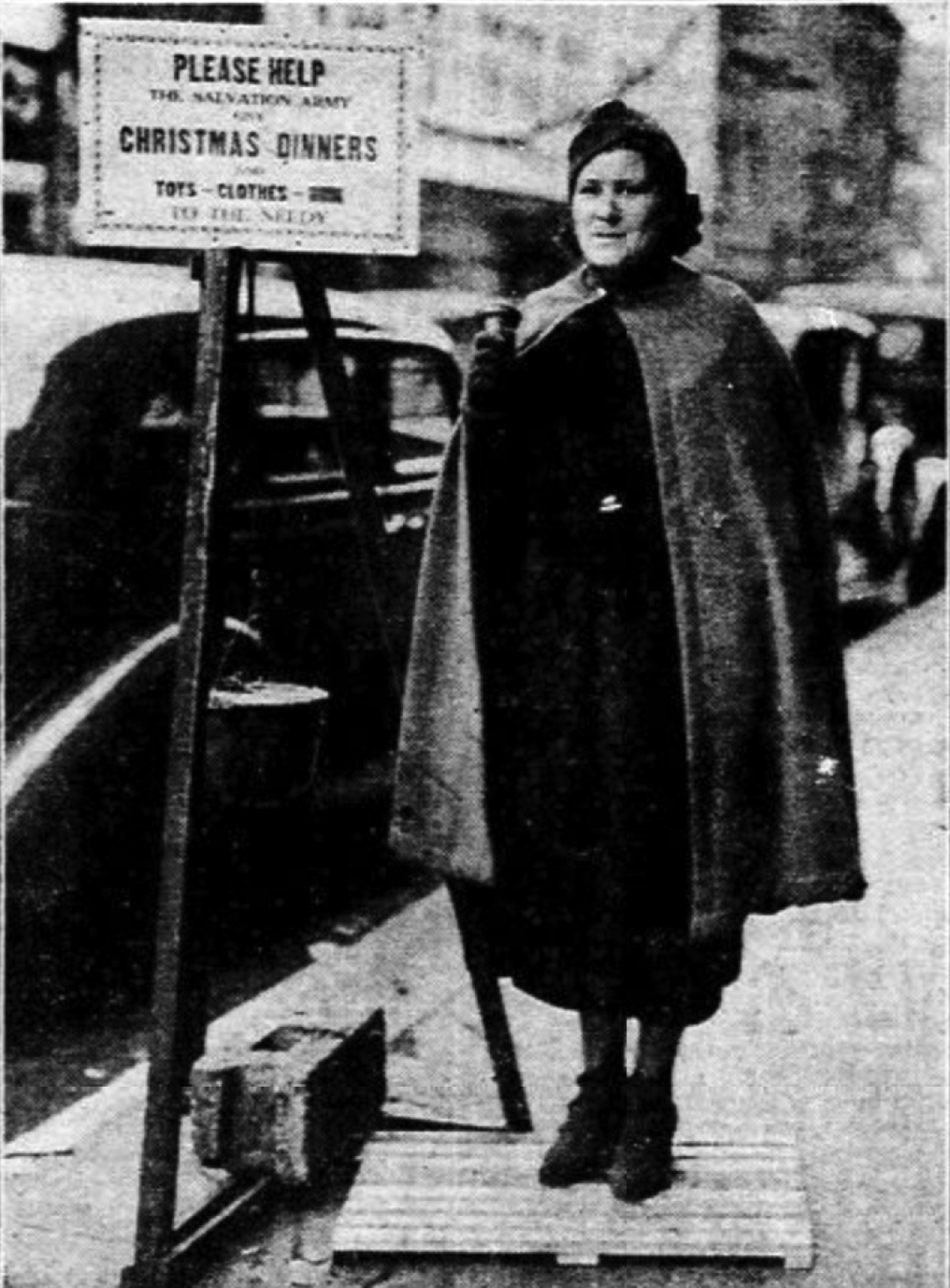
LASSIES DRESS UP
TO TEND ‘KETTLES’
‘Sally’ Girls Don Bright Red Capes and Caps to Ring the Bell for Christmas Funds.
The Salvation Army lassies are adding color to the tinkling of their Christmas fund bells this year. The Yuletide kettles have made their annual appearance in the downtown district, but added to the “please help” plea of the jingling bells are the bright red capes and legionnaire caps of the Salvation Army girls.
The kettles will be kept boiling until Christmas day, when the Duluth branch of the Army will give its annual Christmas dinner for the homeless and carry out other of its welfare activities for the day.
“Three of the ladies of our Home league sewed the costumes,” Adjt. W. H. Wiseman explained today.
Nine kettles have been placed in the downtown and West End districts this year. Four of them will be kept open during weekdays and a of them on Saturdays until shortly before Christmas, when all will be placed in use, Adjutant Wiseman said.
Last year 18- Christmas baskets were distributed by the organization each basket representing $4.50 raised through the kettle campaign. In addition, the funds were used for the annual party and prizes for children of needy families.
 Duluth Herald, Dec. 2, 1946
Duluth Herald
Dec. 2, 1946
West Duluth Methodism
To Be Pageant Subject
The entire cast of the historic pageant depicting the beginnings and progress of Methodism in the western part of Duluth, numbering nearly 100. Will conduct a dress rehearsal Wednesday night in preparation for presentation of the pageant at 8 p.m. Friday in the auditorium of Denfeld high school.
Written by Miss Callie Merritt, granddaughter of the Rev. Lucien Merritt of Merritt Memorial Methodist church, from which the present Central Avenue Methodist church was formed 25 years ago, the pageant will cover a wide range of pioneer history centering around the settlement and development of Oneota.
Represented on the stage will be early settlers, Indians of the pioneer days, pioneer ministers and the “Seven Iron Men” of iron ore discovery and history.
Presentation of the pageant will open the formal three-day celebration of the 90th anniversary of Methodism in West Duluth. Saturday evening, an anniversary banquet will be served in the dining room of the Central Avenue church. Robert Van Kleek, assistant principal of the Coleraine high school, and a charter member of the present church society, will be toastmaster at the banquet.
Sunday at 10L45 a.m., the Rev. William J. Barr, first pastor of Central Avenue, and present pastor of Prospect Park Methodist church, Minneapolis, will preach. The Rev. A. L. Richardson, a pioneer pastor in Oneota, now retired, will speak at 7:45 p.m. Sunday.
 Duluth Herald, Dec. 5, 1956
Duluth Herald
Dec. 3, 1956
New 1-Way Streets
Cause Some Mixups
There was a “little confusion” today as Duluth motorists came through the one-way street system in the downtown district, but Police chief Oscar F. Brewer said “it wasn’t bad.”
Officers expected some confusion while putting the one-way plan into effect, Brewer explained.
The one-way plan permits traffic westbound only on First Street and eastbound only on Michigan street. Downtown avenues are also one way.
Brewer instructed policemen to be at important downtown corners to assist motorists who get aimed in the one-way streets and avenues by traveling the wrong direction.
One of the questions which has come up concerns the way firemen would reach a fire on First street in the area where traffic can move only westward.
Brewer said fire rigs would come from fire headquarters at Sixth avenue west and move eastward on First street to Fourth avenue west, up Fourth Avenue east on Second street and downhill to the fire scene.
The one-way plan on First street ends at Fourth avenue west.
Traffic inspector Howard S. Loraas said the motorists seem to be having more difficulty with the one-way system on the avenues than on the streets.
In some cases, he said, drivers parked at right-angle to the curb were turning the wrong way when backing out of their parling spots.
It was also noticeable today that many motorists were driving by habit, Loraas added. They turned down avenues that they have used for many years even tough regulations may now have the traffic moving in the opposite direction.
The one-way system is expected to get a severe test tonight when shoppers throng the downtown during the usual Monday evening ours when stores are open.
Duluth Herald
Dec. 5, 1966
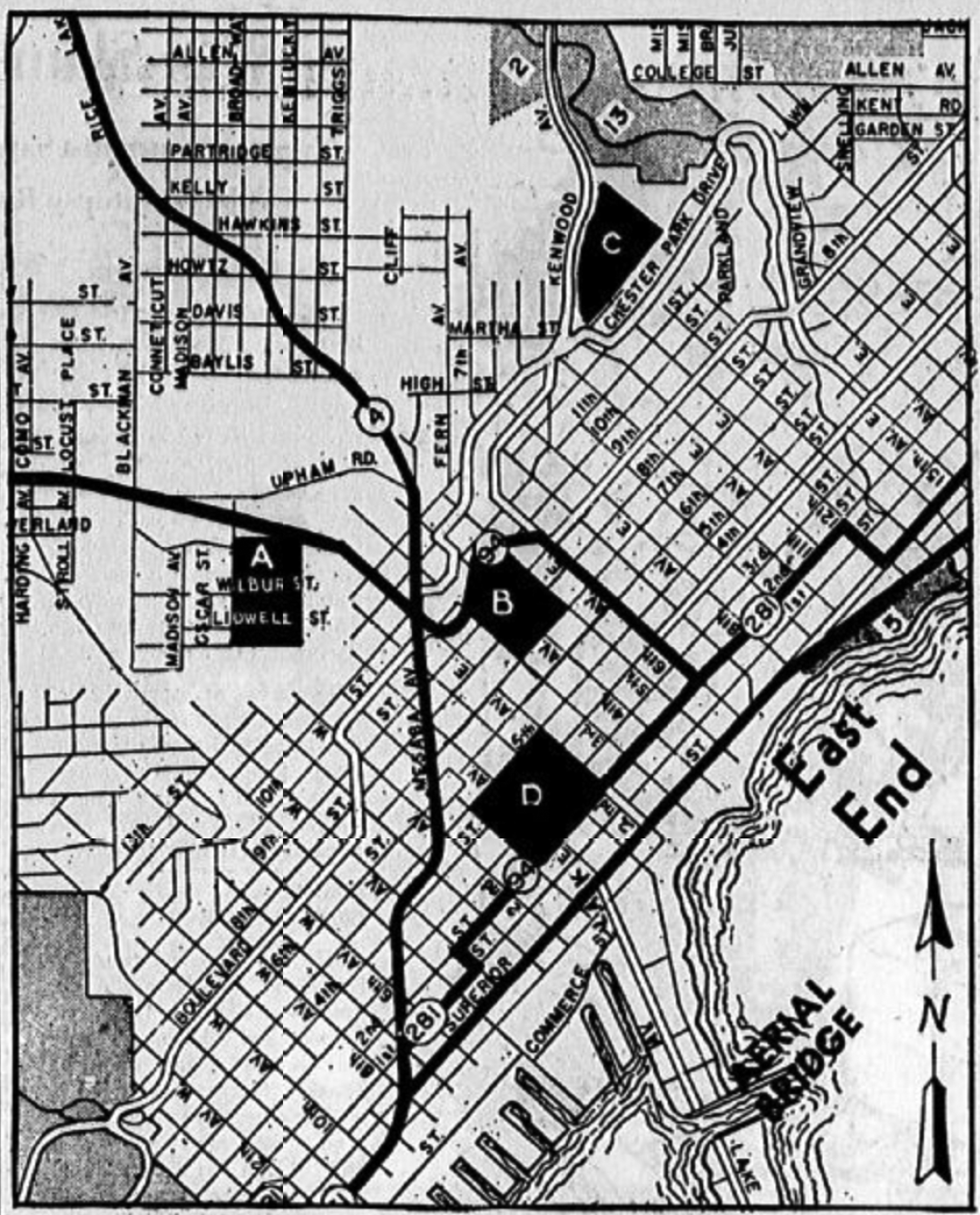
New Central
The four proposed sites being considered by the Central High School Site Committee as possible locations for the new $3.3 million Central High School are pictured above. The boundaries show the general areas under study. Area A represents the 40-acre site behind Harbor View Homes, near the water reservoir off Central Entrance. Site B is the area surrounding Franklin Elementary School bounded on the east and west by Third and Fifth Avenues East and on the north and south by Seventh Stret and Highway 94. Area C is bounded by Kenwood Avenue, Skyline Boulevard and Chester Park. Site D encompasses the present Central location, bounded on the east and west by First Avenue West and Second Avenue East and on the north and south by Second and Fifth Streets. The 57-member citizens’ committee is scheduled to report to the Duluth Board of Education on Dec. 13 with its findings and recommendations.

| Tweet |