




News & Articles
Browse all content by date.
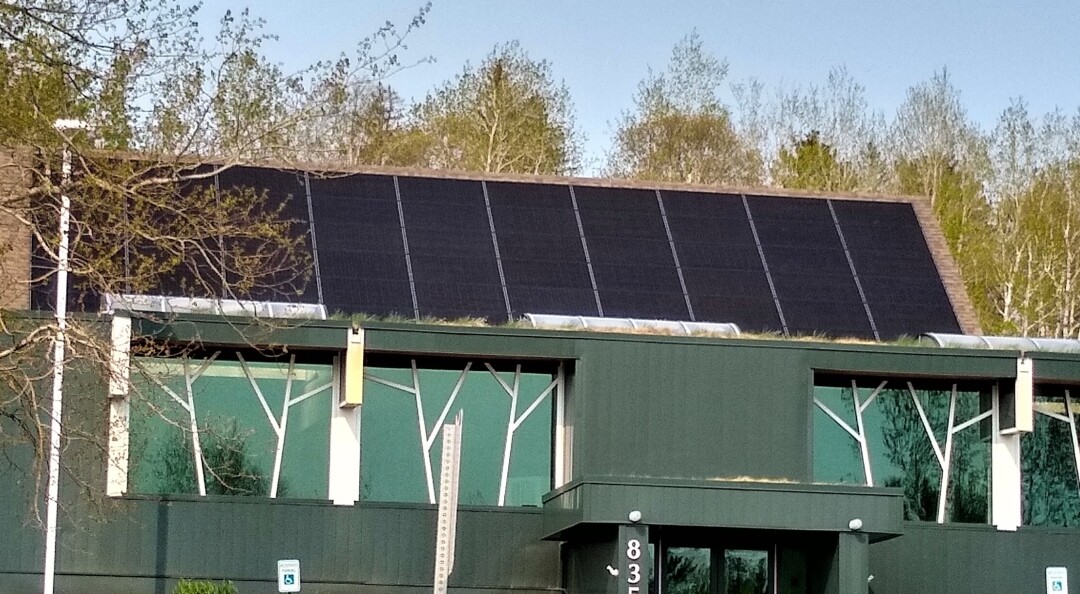
What happens when a solar array is connected to a storage battery?
You create a microgrid to serve your facilities.
That is what the Unitarian Universalist Congregation at 835 W. College St. created this summer, with the addition of a solar storage battery to the 34.4kW solar array installed on its roof in 2023.
The battery provides two main functions – it will supply backup power to critical circuits in the building in case of weather or other outage, and it will also provide supplemental power to the building at times of high demand, thus lowering the use of power from the grid and the monthly electric bill.
The solar array plus battery is a practical action taken by the congregation that aligns with the UU Seventh Principle, “respect for the interdependent web of all existence of which we are a part.”
An initiative of the Climate Action Team, it reflects the goal of moving toward a clean, efficient energy system, with the array providing more than 40% of the electrical needs of the building each year. The addition of the battery not only reduces demand on the electrical grid, but is also a step toward becoming a “climate resilience hub” – a place where people could gather and rest with clean air, power for devices both medical and personal, heat and good company during challenging climate events.
The installation at UUCD is a first for this region – the first commercial solar plus storage system for a building approved by Minnesota Power.
It is a small example of a microgrid, an increasingly common response to assuring power during adverse climate events. It has the added benefits of reducing electricity demand and costs during times of peak power usage.
A microgrid is defined as a small-scale, controllable power system with one or more generation units connected to nearby users, that can operate with, or independently from, the local transmission grid. In the case of UUCD, the microgrid works as a supplement and backup for Minnesota Power’s grid, as the solar array and battery do not cover all of the regular electricity needs of the building.
The UUCD battery installation, like the 2023 solar array, qualifies for a federal incentive payment of 30-40% based on provisions for commercial-level installations in the Inflation Reduction Act (the IRA) that are still in place despite many federal cutbacks in other incentives.
In addition, the Minnesota Department of Commerce offers a Battery Energy Storage Incentive tied to a solar array for both commercial and residential customers.
The base funding was provided by contributions from congregation members. The system was installed by Star-Power-Electric, a local contractor specializing in solar arrays and storage batteries.
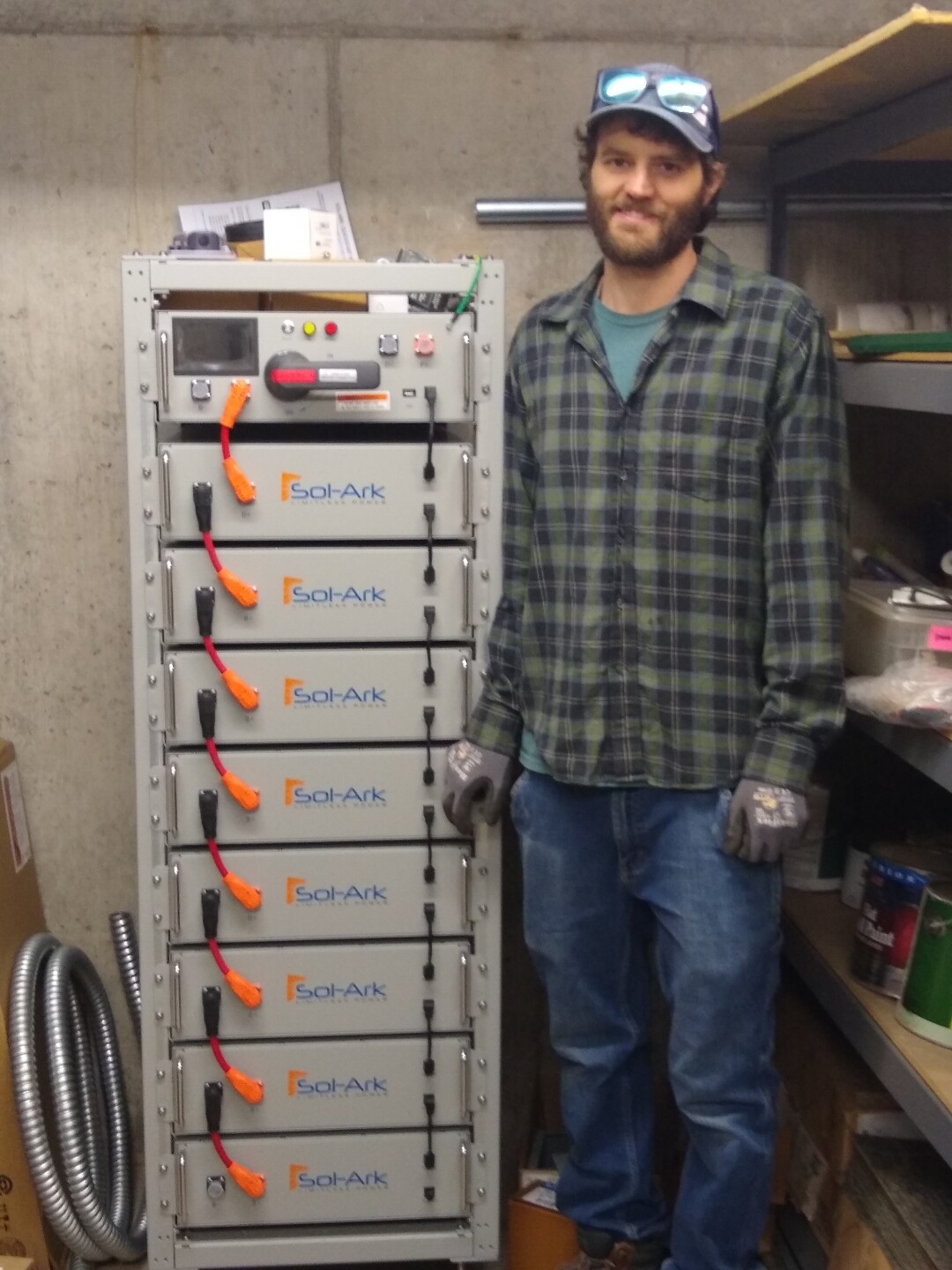
John Goeke, owner, guided the UUCD team through the process, as both his knowledge and patience were required for learning about and adopting a new technology.
Star-Power-Electric also was the contractor for Gloria Dei Lutheran Church, which installed a similar microgrid system this summer.
Both congregations are active members of Minnesota Interfaith Power & Light, a statewide nonprofit focused on climate justice and resilience, which provides support and resources for clean energy and resiliency projects by home owners, congregations and non-profit organizations.
Beth Tamminen chairs the UUCD Climate Action Team. Beth is a retired adult education professional who focuses on issues of climate and social justice and recharges her own energy through her connections with the natural world. Minnesotans have a long history of observing nature and being stewards to the land. There are many regional groups that have documented and continue to observe local species of interest, sites or questions that affect people and communities in the northland. Building on this long tradition, I started a monitoring program based in Duluth for trees called Nature’s Timekeepers. In this program, I collaborate with volunteers who monitor trees at three sites (Lakewalk, Bagley Nature Area, and Boulder Lake Environmental Learning Center) throughout the year. The volunteers track the trees and record when trees develop leaves, flowers and even when their leaves turn color. Our three sites are unique because they vary in how much their climate is impacted by Lake Superior. As a result, the data we collect shows us how growth along the shore is different than inland. We see that the timing of leaf color change is later near the lake and leaf out is earlier inland. We also see how much the lake temperature impacts the nearby land from year to year.
Bagley Nature Area Lakewalk
Because of the dedication of people like you, we are starting to understand how Lake Superior is impacting our forest, how our forests are uniquely adapted to life by the lake, and what our forests will look like in the future. In addition to thinking about climate change, our research is exploring what are the best trees to plant in coastal forests. You can contribute to this effort by becoming a timekeeper either in our program or on your own by recording phenology data. You can make a difference in our understanding of the future!
If you want to learn more about Nature’s Timekeepers or using Nature’s Notebook, reach out to us at superiorphenologynetwork@gmail.com. We organize annual workshops in the spring for new volunteers or people who want to learn about monitoring phenology in their backyard.
Biography: Dr. Jessica A. Savage is an Associate Professor at the University of Minnesota – Duluth. Her expertise is in plant phenology, physiology and ecology. She is currently conducting research in coastal forests along the shore of Lake Superior. She is the founder of the community science program, Nature’s Timekeepers. She got her PhD from the University of Minnesota – Saint Paul.
| Tweet |