




News & Articles
Browse all content by date.

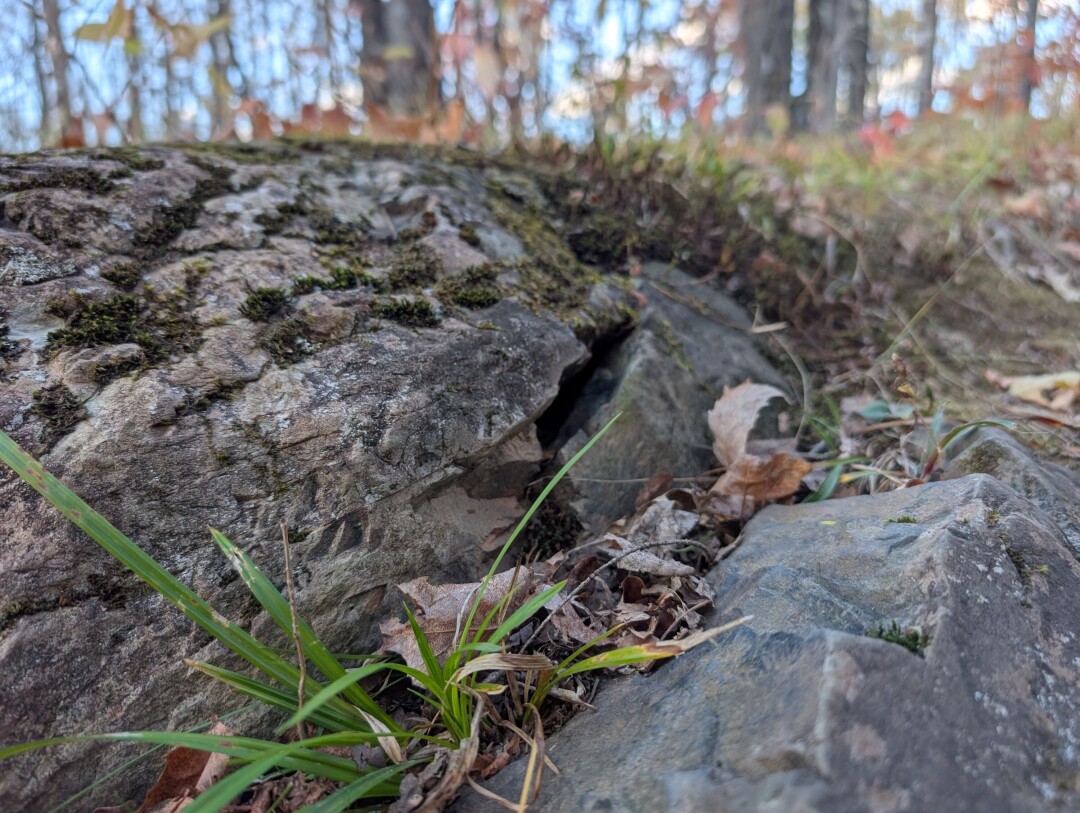
Once the snake entered this rock crevice, the body followed the head like a piece of spaghetti being slurped into the earth. Photos by Emily Stone.
The forest of fall colors visible from my favorite rocky knob were past peak, but yellow, green and orange aspen leaves still glowed among the gray twigs of the maples.
Temperatures were sinking in tandem with the sun, so I didn’t tarry too long on this after-work hike. A flash of movement on the narrow trail snapped me out of my thoughts and brought me up short.
The garter snake must have been using the last rays of sun to warm in the middle of the trail. Being ectothermic and using the environment instead of their metabolism to regulate their temperature means that snakes need less than one tenth of the food required by a mammal of a similar size.
It’s very efficient, except when the warmest surfaces are traversed by humans.
My eyes barely registered the snake’s dart to safety and still my brain knew exactly what was going on. Once we were both frozen in place, it took me several moments to spot the parallel ribbons of black and pale green in the dry leaves on the edge of the trail.
The red forked tongue darted out to gather chemicals from the breeze. Head up, the long, muscular body tensed and then began moving forward, the back half of the body tracing the same sinuous path that the front half pioneered. Where would it go?
I was mesmerized by the effortlessness of the movement back across the rough dirt path. It brought back physical memories of roller skating as a kid and the challenge of propelling myself forward using only subtle pressure on the insides and then the outsides of my wheels.
Even as the snake climbed a small slope of bedrock, I could see how slight curves of the body found purchase on slight irregularities on the rock and conspired with belly scales to enable forward movement.
This technique is called serpentine motion, and is the most common way for garter snakes to move.
On especially slippery surfaces, garter snakes might attempt a sidewinding motion, but it’s not as coordinated as when a desert snake loops around to avoid touching hot sand.
In confined spaces, where S-curves are limited, garter snakes may expand forward, hook their scales on some small notch and then pull the rest of their body along in a motion resembling an accordion.
Nosing between two rocks, the snake seemed to be searching for something. But no, that wasn’t the place.
It swung around and moved along the base of the rock until reaching a long crack. Tongue flickering in apparent recognition, it lifted its head up toward a wide place in the crevice, nosed in and began disappearing into the dark.
The stripes flowed forward as if the rock was slurping them up like long, wet spaghetti noodle.
And then the snake was gone.
Using the flashlight on my phone, I peered into the crevice. A smooth tunnel of soil vanished into the earth. What lay beneath?
This outcrop of rock had been a jumbled flow of ‘A‘ā lava just 1.1 billion years ago during the Mid-Continent Rift. During its life of being buried and excavated, the rock had become both more smooth and more fractured.
Although the volcanic heat was long gone, the warmth of the summer sun would be stored in the bedrock. As long as the snake could wiggle its way below the frost line where the temperature would remain above freezing, this would be a good place to spend the winter.
Large numbers of garter snakes often gather in crevices like this one, or burrows or basements, to snuggle in and share body heat throughout the winter.
In their hibernacula, these cold-blooded beings enter brumation, which is a slowing of their metabolism, breathing, and heart rate that is similar to hibernation.
Thinking back, I can remember seeing a garter snake in this exact spot at least one other time. And I’m pretty sure that the front of a hiking group saw them several more times while I was at the back helping people down the steep slope from the overlook. It would make sense, since good hibernacula are used year after year.
Tummy rumbling, I sped up on my way back to the car. The snake’s belly was likely even emptier than mine, since they make a point to stop eating well before brumation. It’s best if all of their frog snacks or toad tidbits are digested and absorbed before their systems shut down, or else the food will decay instead of digest and make them ill.
Perhaps it had been sunning itself in the trail in order to speed the processing of the final fall meal.
No sun remained now, as both the day and the season darkened toward the coming winter.
Emily Stone is Naturalist/Education Director at the Cable Natural History Museum. Her award-winning third book, Natural Connections3: A Web Endlessly Woven, is available to purchase at www.cablemuseum.org/books and at your local independent bookstore, too. Our Fall Calendar is open for registration! The new exhibit The Wetland Way is now open! Discover how life thrives at the intersection of soil and water. Follow us on Facebook, Instagram, YouTube, and cablemuseum.org to see what we are up to

| Tweet |