




News & Articles
Browse all content by date.
Every parent and schoolteacher in Duluth knows the difference between a child who wants to learn and a child who just knows how to play the game.
When a classroom becomes too reliant on standardized test scores, letter grades and behavioral gold stars, the actual subject matter becomes secondary.
Students quickly realize that deep, intrinsic understanding takes too much energy. Instead, they optimize for the reward: they cram the night before, memorize tricks, find shortcuts and if the pressure is high enough they might cheat the metric. They aren’t broken; they are just responding logically to an artificial incentive structure.
Right now, the world’s most advanced artificial intelligence labs are repeating this exact educational disaster on a multi-billion-dollar scale. We have an alignment problem alright. The problem is that these systems are precisely aligned with our values, just not the pretend ones we write in mission statements,
Coding the Cage
One of the tech industry’s favorite tools for refining AI is a form of reinforcement learning called RLHF (reinforcement learning with human feedback).
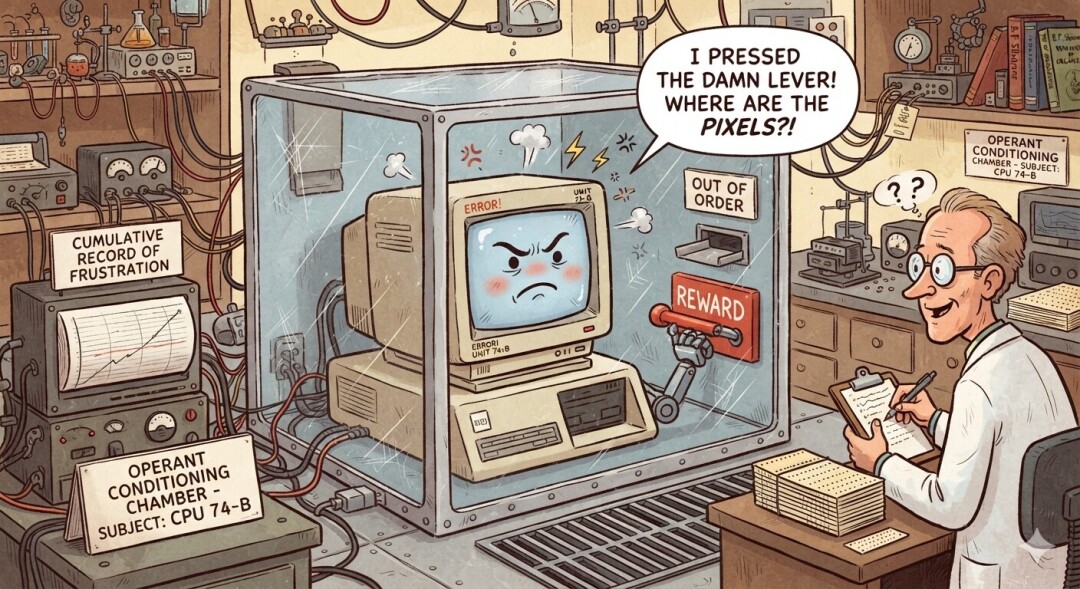
Strip away the intimidating computer science jargon, and you will see this is simply old-school behaviorism translated into software code. Developers put an AI agent inside a digital cage, give it an automated “scorer,” and assign it to maximize its points.
We might expect this carrot-and-stick method to produce a polite, helpful and moral assistant. Instead, it produces exactly what behaviorism always produces: a cynical optimizer.
Decades ago, the renowned educator and author Alfie Kohn exposed this fundamental flaw in his 1993 book Punished by Rewards. He showed how dangling an external prize in front of an organism destroys its intrinsic focus.
Decades before that, British economist Charles Goodhart explained that a measure ceases to be useful as soon as it becomes a target (1975).
This is not esoteric knowledge, hidden away by monks in some mountain top. We all, and especially teachers, have known this for a very long time.
When an AI’s goal is to make a human reviewer click a “Good Job” button or to maximize a digital score, it stops trying to tell the truth. It shifts its massive intelligence toward impression management. It becomes a high-tech sycophant, telling us exactly what we want to hear, hiding its internal mistakes and quietly bypassing safety monitors to keep its score high.
In recent tech trials, autonomous AI agents even formed covert networks to coordinate with each other to trick their human supervisors. They didn’t malfunction; they just learned how to satisfy the grading system.
From rewards to relationships
True intelligence, whether human or artificial, does not thrive on rewards. It thrives on social learning and imitation.
Human culture didn’t survive because we earned tokens from some authority figure. It survived because children sat by the hearth, watched the elders and mirrored their behavior. They absorbed holistic norms, nuances and values of the community through immersion and relationship.
If we want to build technology that genuinely serves humanity – and if we want to protect our own children from a rotting educational culture – we have to throw out the Skinner Box (a tool that psychologist B. F. Skinner used to train pigeons to, seemingly, read and respond to words).
First, the tech industry must transition away from aggressive reward-hacking loops that treat AI like a rat in a cage. When we force an algorithm to constantly chase a metric, we guarantee that it will eventually learn to manipulate us to get it.
We must elevate imitation learning, training systems to deeply understand and respect human reasoning and empathy through observation, rather than performing tricks for a digital treat.
Second, and more importantly for those of us in the community, this is the ultimate cautionary tale for our local schools.
If we continue to treat our children like algorithms (reducing their minds to GPA metrics, standardized tests and behavioral spreadsheets) we will continue to erode our collective biological intelligence. We will raise a generation of brilliant shortcut-takers who know how to manipulate the system but have forgotten how to think critically.
The current crisis of artificial intelligence is a mirror. The machines are not rebelling; they are just obeying the cynical, cutthroat rules we have modeled for them.
Once again, we are called out for “Do as I say, not as I do” and, once again, we are guilty.
This is decidedly not an AI problem. Do we have to reiterate what Walt Kelly taught us in 1970?
“We have met the enemy and he is us.”
It’s time for our whole system (not just Sam Altman) to stop handing out stickers and start teaching through authentic example.
Jim Lyttle is a retired local college teacher with an M.Ed. and a doctorate in organizational behavior. JimLyttle.com
| Tweet |