




News & Articles
Browse all content by date.
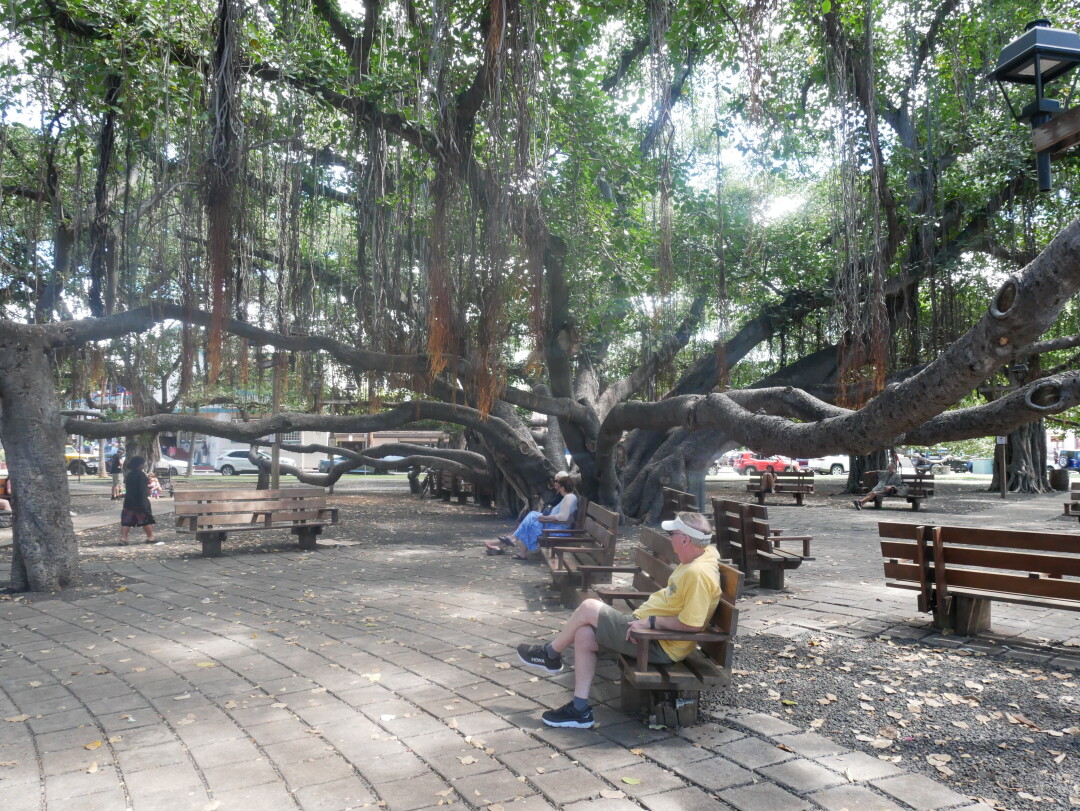 The famous public square banyan tree that escaped the 2023 wildfires that destroyed much of Lahaina, Maui. The wealthy are buying exotic banyans and African baobab trees for their estates. Photo by Jim Lundstrom.
Billionaires used to battle over bathrooms, mansions and yachts
The people who used to battle for economic supremacy by counting bathrooms, the number of mansions owned around the world, and the longest and most luxurious yacht – and never know when enough is enough – have gone to a new war of economic inequality.
The battle is: who has the oldest, largest and most expensive trees?
When billionaire Jeff Bezos of Amazon bought two mansions close to one another in Washington D.C., he combined the two into one and ended up with 27 bathrooms in his East Coast mansion. Along with his other mansions scattered throughout the world, he is the likely candidate of being the most clean of all the wealthy combatants with toilets in the world.
Ken Griffen of equity firm fame owns 11 mansions, the most expensive penthouse in New York City, for which he paid $236 million, and has bought land on an island near Palm Beach where he is building two mansions.
Mark Zuckerberg of Meta owns five mansions, one on a Hawaiian island he bought which will serve him as an end-of-the-world bunker to protect him when he and his fellow billionaires blow up the world in culture wars and climate change.
Elon Musk, just short by $50 billion of being a trillionaire, claims he does not own a home but just shacks up at one of his businesses. He has fathered 14 children by 5 women. A culture warrior, he says a trans daughter is dead.
Microsoft’s Bill Gates has purchased more than 200,000 acres of good farmland in the Divided States of America.
Ted Turner of cable news and Jane Fonda fame had owned more than two million acres of range and plantation land before he died.
How and why did these billionaires become wealthy without ever thinking they had enough?
Perhaps Lindsay Owens, an economic sociologist and director of the Groundwork Collaborative, a think tank in Washington that studies the American economy, has some answers: “I cut my teeth in academia and the Senate studying the ruthless form of American capitalism that’s centered around it: bust unions and keep wages down, Pass NAFTA and outsource labor, bring in the bean counters from the big four accounting firms and ask: How do we limit our regulatory costs? We are living through the reinvention of the ripoff. Nothing short of a consumer uprising and a slate of tough new rules is going to fix the problem. We need a shopper’s bill of rights passed by local and federal governments to establish new rules.”
What would happen if we gave
a homeless person an apartment?
Americans might ask why Scandinavian countries always end up being in the top five of the United Nation’s Happiness Country polls. It’s because they practice forms of capitalism combined with Democratic Socialism.
Some people label it Democratic Capitalism. Finland is at the top of the 2026 poll. A homeless person in Finland is granted an apartment. Read about it.
Here’s the Top Ten in 2026: (1) Finland, (2) Iceland, (3) Denmark, (4) Costa Rica, (5) Sweden (6) Norway, (7) Netherlands, (8) Israel, (9) Luxembourg, (10) Switzerland.
The Divided States of America is in 23rd position in the poll, in front of Saudi Arabia and behind Poland. Afghanistan is last of the 147 Countries ranked.
Most of the top 50 countries can grow big trees and many even have billionaires. Someone will have to estimate when entrepreneurs run out of big, mature trees!
At last official count there were 3,428 billionaires on earth according to Forbes surveys in 2025, with 902 living in the Divided States of America. Estimates by economists in 2026 say we have already topped 1,00 – so far. We know the climate is changing from the number of violent storms and the increasing heat that are hitting countries around the earth every day, costing billions in damages and causing thousands of deaths. American billionaires have been battling for years to have bigger mansions and superyachts to see who has the mostest and the longest.
A large mansion may use as much energy as a small town. A superyacht in the 400600 foot range may use as much of the earth’s resources in a year as a small country.
Who would pay $500,000 for a tree?
A billionaire, of course!
Moving huge trees is not new. The English aristocracy was doing it in the 18th Century to improve castle grounds. Hundreds of people were utilized in moving just one tree, but it wasn’t a pyramid.
Guy Trebay of The New York Times covered the subject in “The Latest Wealth Flex: Big Trees.” He quotes a co-founder of Environmental Design, a Texas company that moves some of the biggest and heaviest trees on earth: “Every day, that’s what we do. People who can afford it want the biggest, and they want the best in everything, and they want it now.”
An architect who works with him states: “Of course, people have done big trees before, but not at this scale. The money now is out of control.”
I think the 25,000 homeless people in Los Angeles already know that. Big trees are being moved to the wealthy Hamptons and Silicon Valley almost every day to make new and old mansions and grounds look as if they have been there a long time.
Big trees are loaded on special semi-trucks which must travel routes that don’t have bridges or overpasses – or narrow roads. Here are a few scenes of how big trees are used to impress other billionaires:
• A Florida landscape firm planted two banyan trees on a Palm Beach estate of a billionaire, each costing $250,000.
• An African baobab tree is becoming more popular with architects of billionaire estates because it is quite unusual. It comes in various species and sizes from between 18 feet and 100 feet tall. It has a very thick and swollen trunk that can grow up to 30 feet wide at the base! It often looks as if it is growing upside down. The branches are short and stubby and sit at the very top. looking like roots. It often has no leaves for as long as 10 months of a year. The branches often look like roots reaching for the sky. Native to parts of Africa and Australia, this tree has become “fashionable” to billionaires familiar to the art world. Many are being shipped around the world. It takes a very specialized crew of workers to dig one up and prepare it for shipping. A whole subculture has developed around it, and the tree is coveted by art lovers. A Florida hedge fund billionaire recently paid $500,000 for one mature one.
• Stephen Schwartzman, CEO of Blackstone private equity company, and Larry Ellison, CEO of Oracle, the data and software storage company, have a public duel about their mansions in Newport, Rhode Island. Schwartzman owns Miramar, an old oceanfront 30,000 square-foot mansion designed in the early part of the 20th Century. He has done extensive remodeling of the classic structure. Ellison has added dozens of mature trees and dozens of old boulders to the lawns of his estate. The mansion was previously owned by the wealthy and famous Astor family. Schwartzman is adding hundreds of American holly trees that reach 18 feet to shield his estate from prying eyes. Mariah Whitmore, a nursery owner who supplied the holly trees, said: “It’s all about instant gratification for billionaires. Budgets have grown, trees included, It’s about the immediacy.”
• Landscape designer Tanya Keller has supplied trees for three decades around Newport and has some interesting comments about her dealing with the rich and competitive: “It’s always boys and toys. Yachts, houses, art, trees, it’s always essentially the same thing. It’s my tree is bigger, my crane is taller, than yours.” I wonder if her comments have cut into her sales.
• One of the richest men in the world around the turn of the 19th century, Andrew Carnegie, built thousands of libraries in the Divided States of America (Yes, it was divided then also!) after gaining a fortune from the steel business. A very generous “billionaire” who helped “civilize” many a small city with a library, Carnegie also bought a lot of big trees. In 1901, Carnegie bought 30 trees, some more than 60 feet tall, to grace his new mansion built on the famous Fifth Avenue in New York City.
While big trees multiply, little children are not being born
Why? Margaret Talbot has answers in her New Yorker article “Baby Steps.”
Why do people have fewer children? Is it because they no longer want them? Or is because billionaires have bought too many mansions, superyachts and now the leading symbol of success, lots of big trees on beachfronts and surrounding big estates to impress the locals?
Here is her answer: “Social and economic conditions are needed to create the families they hoped to have had.”
(What is the cost of raising a child to the age of 18 now? Two years ago it was estimated to be $311,000. With the increases in the cost of living in the last two years, could it be near $400,000 today?)
“Housing is ruinously expensive. Childcare is costly, too. Jobs are demanding and insecure. Finding a reliable partner can feel harder than ever.”
Other writers have added to her list: cost of healthcare, cost of higher education, fear of climate change, feelings of precarity, and the real danger in finding a reliable, loving co-parent.
Another reason: we are living in a period of fertility decline we haven’t found the answers to yet. Global fertility rates have fallen from about five children per woman in the 1960s to 2.2 children per woman in 2024.
Countries representing 70% of the world’s population have fertility rates below the replacement figure of 2.1 children per woman. The rate in the Divided States of America is now 1.6.
In very crowded South Korea, the replacement rate is now below one child per woman. Remember when China had a limit of one child per family?
In our DSA, almost half the women aged 30 are childless, compared with 18% in 1976.
Could the best reason be that multi-millionaires and billionaires have too many pieces of the economic pie? Have they bought too many mansions, superyachts and trees instead of paying their share of taxes?
| Tweet |