




News & Articles
Browse all content by date.
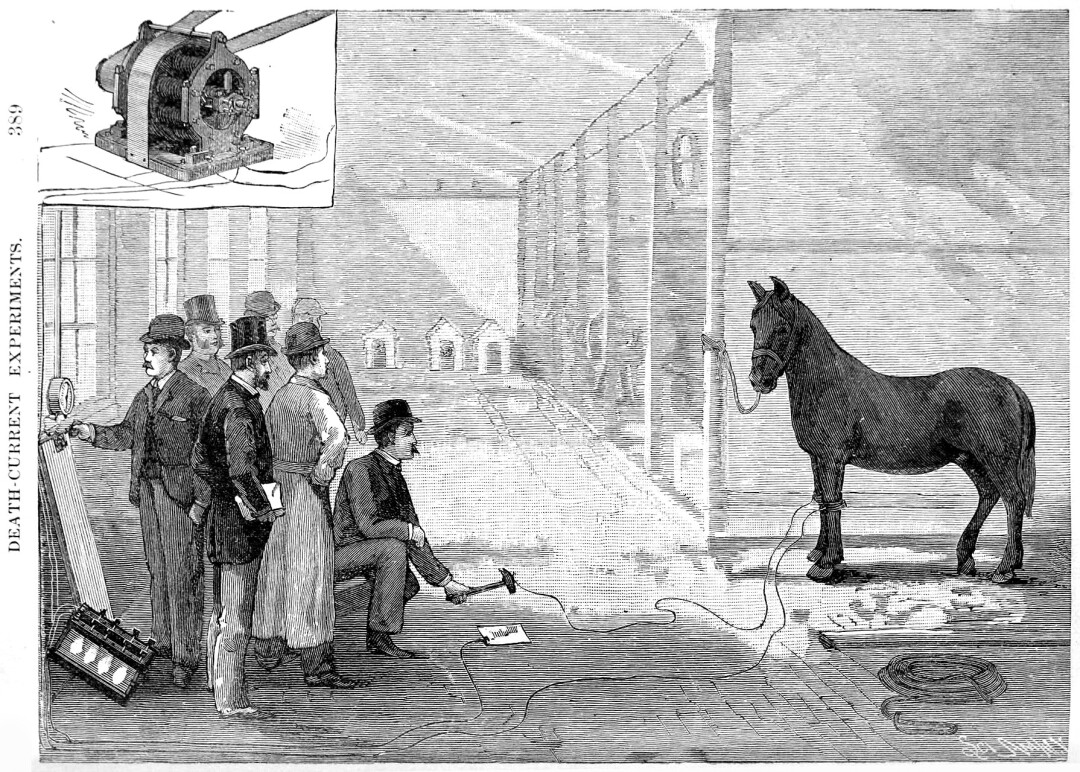
Harold Brown demonstrating the killing power of AC to the New York Medico-Legal Society by electrocuting a horse at Thomas Edison’s West Orange laboratory. The illustration appeared in the New York Medico-Legal Journal, Dec. 22, 1889.
I’ll assume you’ve heard a few “three way” jokes. Three is a useful number for remembering things or making open comparisons. That’s what the title is about, except with diversity of spelling and association to make things more, well, less like the past.
Tree whey isn’t a’tall gram matical, ‘zit?
But, with but one t, as students did not like this Im’a mind to say Why not you, Reader reader? Y knot chew?”
In plainer speech-spooch the three things I say to look for as useful guides to what’s on going are: Descriptive. Prescriptive. Proscriptive.
They look a happy trio of grammar gods, but O they are not. Of the three, description, I believe, most favors the reader or audience by trying to be an accurate rendering of something seen, heard, experienced, etc. Description has limits.
Try describing a chocolate sundae. Weight, measurement, color might go OK, but what about taste and texture, etc.?
The person doing the describing has to adjust to take into account what the reader-listener may or may not be familiar with. And, of course, subjectivity works in multiple directions at once. A good description is an honest attempt. Poor description misses that mark.
Any of these can be used and or misused or both. But prescription and proscription are easier to abuse because they start out telling the listener-reader-audience what to do/believe or not believe/do.
That makes description somewhat more neutral. May and can be slanted, but if it’s true description it records rather than directs. If I describe something I’m telling what it looks like, color, size, weight, sound, etc. where a prescriptive or proscriptive approach tells you what to think about it or what value (value, not price – there is a difference) you should place on it. In our world, as I describe it, I see mostly salesperson prescription and proscription telling others what they should do, be, think, wear, support, reject, etc.
That’s what I see and have just described.
But the thing is, what did you see or hear? A lot, a cussed damn awful lot, of what we’re told to see is stuff that can’t be seen. Ever notice that?
From the time of earliest childhood the scary thing is unseen, under the bed, hiding in a closet, in the darkness where it waits. And when I say there’s a lot of that I’ll explain.
After my bogeyman days I was told to worry about nuclear war, acid rain, an imminent ice age, nuclear fallout and so on. Like the monster under the bed, I never saw any of those things.
The reefs did not disappear, the birds did not die and the earth did not cease function. We don’t, because it’s not possible, see things that don’t occur, that don’t happen. Being told it’s happening doesn’t make it so.
But the greatest of all the unseen terrors of late was COVID. Did you see a single such virus? I didn’t.
I did see lots of the fear that spread in a contagion I thought might be as bad or in ways worse than the evil flu. When you see, as I did rather too often, people outdoors masked or driving alone and masked on a rural road you could reasonably conclude we’d been over-scared. Respect for a virus is one thing.
Turning lives, businesses, relationships, and etc. back-end-to was not about the virus. At least as I saw it, the virus became a bogey, a tool to achieve other ends.
Of course, as the Frankenstein monster said, fire bad, and so virus bad, too. We all knew that. But how bad? Certainly, as it played out, not pandemic bad. Demi-demic maybe.
The various prescriptions and proscriptions regarding the virus, regardless of how well intended, were in my view failing to look, to describe what was going on instead of what was feared (and in some cases desired).
Living with us human beans isn’t easy. We’re often som’at nuts. Take Y2K when all the computers would run amok and we’d descend into useless barbarity. Remember that?
Hard to because it didn’t happen, but was predicted. Now, I’m not taking credit here, but I had Y2K under control. When the fatal day arrived I had a Jew and a Chinese on hand. Different calendars. No problem, or in the Y2K case, problem solved.
You can thank me for handling it for all of you, which you know makes as much sense as if I’d been on the warning side of that equation. Invalid is invalid. That something might happen is not good enough to head for the hills.
Those who yearn for equality and equity try the equator; that’s your best shot. Not perfect, but the best shot which will get very crowded if to many of us seek that same comfort. We won’t all fit, or like it if we did.
In any case I open-arm welcome the current datacenter bogey eating up energy, draining water supplies, and plotting the killing of us all.
So far, next to nuclear war and winter and the predicted ice age, the age of the datacenter is a pretty damn promising disaster. We’ve got a new contender for best end of the world.
None of us alive to recall an earlier really big end o’ the whirled commotion over AC.
T. Edison, a modern hero, inventor and genius (so was oft’ said) warned in graphic and desperate words the fate awaiting all if (heaven forbid) we poor earthly beans were ever to welcome AC instead of good ol’ safe DC power.
Edison and friends showed the danger by electrocuting various creatures as a warning to the public.
See! It’ll kill you same as it will a dog or cow or horse.
But we all use AC current, don’t we? Aren’t dead of it, are we? Able to manage the danger, seems.
Edison was heavily invested in DC production so maybe that was on his mind. Plus, Edison didn’t much like Tesla or Westinghouse, the AC advocates. Hmmmm.

| Tweet |