




News & Articles
Browse all content by date.
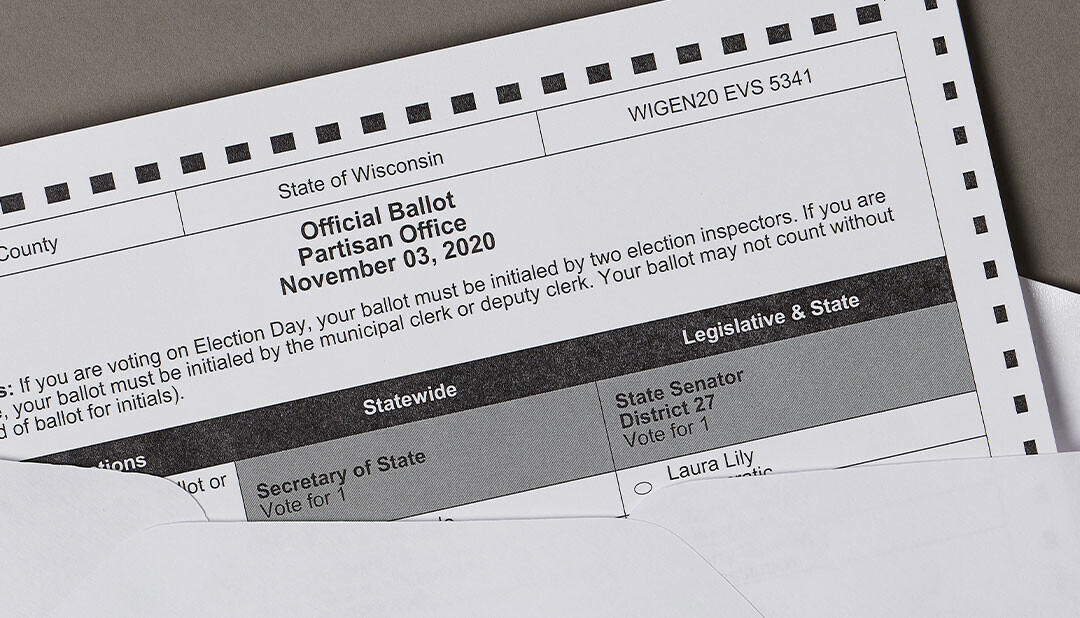
There are three constitutional amendments on the Wisconsin Nov. 3 election ballot. Most voters have probably not heard about these amendments or have not investigated what they are about. Many voters will read the ballot “cold turkey” with no information to make an informed decision. Plus the wording of two of the ballot questions is misleading.
The Republican-controlled legislature is once again playing political games with the constitutional amendment process. Knowing that Governor Evers would veto their bad social polices if enacted with legislation, they are using amendments to advance their agenda. In Wisconsin the governor has no veto power over constitutional amendments.
These constitutional amendments are not needed and can result in harm to people and important public activities in Wisconsin. This is why the nonpartisan Wisconsin League of Women Voters is recommending people vote “no” on all three amendments. Here is are the three questions that are on the ballot.
Question 1: “Places of worship. Shall section 18 (3) of article I of the constitution be created to provide that the state or a political subdivision of the state may not order the closure of or forbid gatherings in places of worship in response to a state of emergency at the national, state or local level, including an emergency related to public health?”
This is simple bad policy. Necessary public health measures during pandemics and other emergencies should apply to everyone and all organizations in order to protect and limit the harm to everyone. There is no reason to exempt religious gatherings. Nor is this damaging to religious freedom.
Governor Evers’ executive order to limit the size of gathering was a legal, rational, necessary effort to contain the spread of disease.
During the COVID pandemic there were many political battles between the Republican-controlled legislature and the governor over how to deal with the pandemic. The legislature tried to interfere with the governor’s legal authority to manage the crisis. They opposed Evers’ executive order prohibiting meetings with more than 10 participants (closing businesses, churches and schools), mask mandates and immunization mandates.
One suspects the Republican’s now proposing this harmful and unnecessary amendment is an attempt to stir up controversy and increase voter turnout from the religious nuts. It certainly is not an issue meriting a constitutional amendment.
Question 2: “Governmental entity discrimination prohibited. Shall section 27 of article I of the constitution be created to prohibit governmental entities in the state from discriminating against, or granting preferential treatment to, any individual or group on the basis of race, sex, color, ethnicity or national origin in public employment, public education, public contracting or public administration?”
This wording is deliberately deceptive. This amendment is not about outlawing discrimination. Federal and state law already does that more broadly than this amendment.
The real intent is shown in the phase “granting preferential treatment.” This is about Republican’s opposition to Diversity Equity and Inclusion (DEI) programs and ending diversity initiatives in government contracting, hiring and education that seek to counter prior discrimination and prejudice through creating opportunities for historically disadvantaged groups to better compete with traditional winners. This amendment could make it illegal for government to help people who need help.
The League of Women Voters says, “If this amendment passes, it will eliminate the equity-based gains Wisconsin has made over the last 60 years...While framed as promoting equality, this amendment would reduce Wisconsin’s capacity to address long-standing disparities. It would strip public systems of tools essential for promoting equal opportunity and equitable access to the vulnerable in our society.”
What could be the specific impacts? We know that minority women have higher rates of chronic illness, disease, mortality and child mortality. Targeted health programs could be ended.
In education accommodations and special programs for poor, homeless, non-English speaking or gifted and talented students could be eliminated. University admissions, scholarships, grants, ethnic studies courses and textbooks that discuss minority issues could be targeted.
Community action programs like Head Start, food banks, homeless shelters and domestic violence shelters could lose government support and funding.
Public contracts for certified women- and minority-owned firms will be impacted. Workplace initiatives to promote equal employment opportunity in hiring, training, promotion and retention could be killed.
There is a difference between equality and equity. Not everyone starts from the same base of social, financial or educational background. Often these disparities result from systematic past discriminatory government policies. So it is not “reverse discrimination” to provide help to overcome past discrimination.
Achieving equity – actual equal opportunity – requires more than treating everyone the same.
Question 3: “Partial veto. Shall section 10 (1) (c) of article V of the constitution be amended to prohibit the governor, in exercising his or her partial veto authority, from creating or increasing or authorizing the creation or increase of any tax or fee?”
This amendment is part of larger, ongoing effort by the Republican-controlled legislature to weaken the powers of Gov. Evers. They have taken numerous actions (even before he was inaugurated in 2019) to reduce his executive authority.
Specifically it is in reaction to Evers’ “400-year veto” that provided a $325-per-pupil increase for school funding. This was a ridiculous move by Evers’ in the ongoing power struggle. But if lawmakers think the governor’s veto powers are too strong (which they are) they should address that with legislation or a comprehensive constitutional amendment, not a narrow issue of one veto by one governor.
Constitutional amendments should be for establishing major legal, civil rights, public policy principles, government functions and responsibilities. They should not be used for minor or politically fluctuating issues. These are better handled with administrative or legislative action.
Constitutional amendments should be worded so the public can clearly understand what they are actually voting for or against. Republicans frequently use deliberately deceptive wording that sounds good, or appears innocuous, to most voters when it has hidden bad consequences.
In many areas of human rights and public policy, Republicans not only don’t care about harm done, but are actively working to restrict options and freedom for the majority of people. Don’t be fooled. Vote “no” an all three questions.

| Tweet |