




News & Articles
Browse all content by date.
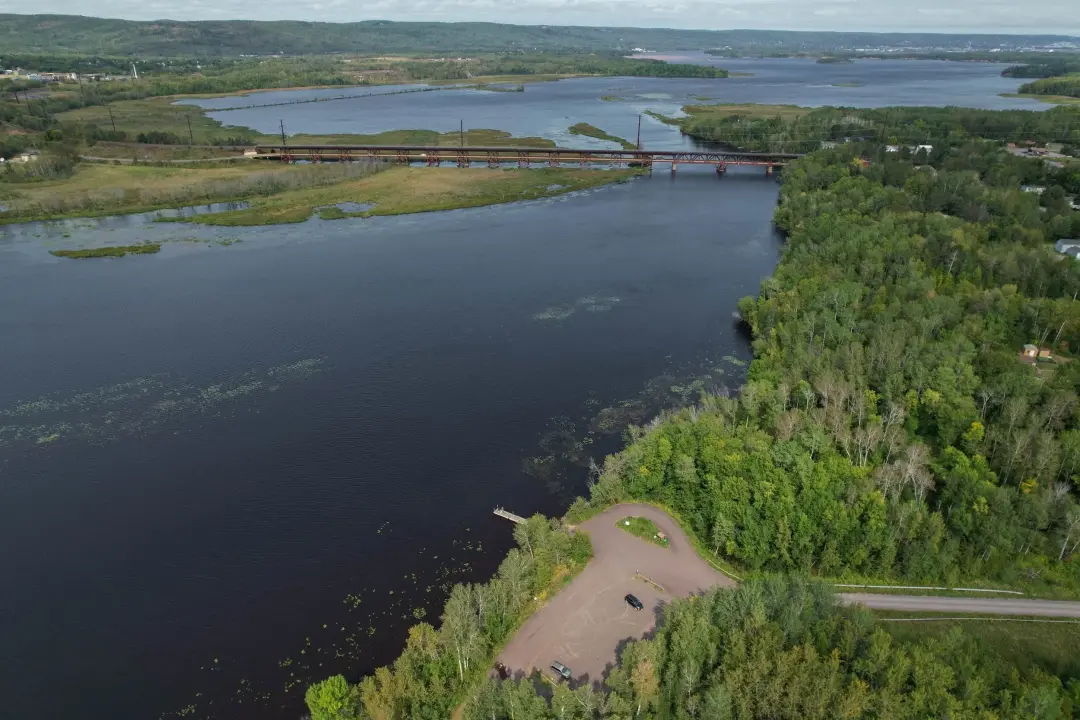
The Oliver Bridge across the St. Louis River. After treatment, Hermantown’s wastewater, including that of the proposed data center, is discharged into the St. Louis River. Photo courtesy the St. Louis River Alliance.
The proposed hyperscale data center in the rural, residential Adolph neighborhood area of Hermantown is a 1.66 million square foot, 278-acre project, with possibility to expand to 800 acres.
A hyperscale data center of this size consumes 400-500 MW, more power than all the residential homes in the Minnesota Power service area, and more power than the entire city of Minneapolis.
The proposed project location is deeply rooted in history, including generations of family-owned agricultural and farming lands, hundreds-year-old oak trees, prairie lands, 58 acres of wetlands, abundant wildlife and designated trout streams.
According to the final industrial AUAR, 10,783 trees, 58 acres of wetland will be converted to 126 acres of impervious surface. The proposed site is in the St. Louis River watershed, an Environmental Protection Agency area of concern. It also is between the Midway River and the West Rocky Run, both cold-water trout streams that appeared in a recent article.
Professional Geologist Lori Huntoon commented during a community event and hydrologist Amanda Bell also commended on the environmental sensitivity of the proposed area.
The proposed Hermantown project is nearly unanimously contested by residents (survey results Feb. 2026 University of Wisconsin-Superior 74.31% strongly oppose or oppose). Land in the proposed development location is legally being appealed for breach of contract.
Directly affected and other area residents of the proposed development did not learn of the project from their elected officials or the developer, but, instead, through an article published by the Star Tribune and only following a data practice act request to the City of Hermantown.
Records reflect that Assistant Hermantown City Administrator Joe Wicklund signed a “Mutual Non-Disclosure Agreement “ on behalf of the “City of Hermantown” with Mortenson Development, Inc. on May 21, 2024. Later data practices act requests reflect additional indemnity agreements between Harmony Group LLC (i.e., Google) and the City of Hermantown agreeing to pay potential legal fees related to claims against the city for keeping the project secretive.
Google’s announcement of ownership of the project on Tuesday, March 3, 2026, came after at least a year and a half (NDA signed May 31, 2024) of secrecy and clandestine efforts by the city to secure the project without public knowledge, input or adequate environmental assessments.
The data center cooling section of the final industrial AUAR is of particular concern. According to Steven Petty, chemical engineer, industrial hygienist and industry expert witness, verbal testimony Ohio Data Center Commission testimony, June 2026, cooling typically involved three loops, a closed loop (susceptible to leakage due to length), an open loop that cools the closed loop, and a third loop in the power plant (perhaps these are the “mechanical buildings” included in the special use permit on the city of Hermantown project website).
The final industrial AUAR mentions 50,000 gallons of domestic water use, equivalent to 30,000 toilet flushes. No industrial water use is mentioned. The amount of municipal water use amount was recently appealed at a Google site located on the Columbia River in Dalles, Oregon.
Personal communication with Kelly Campbell, a citizen watch group member of Columbia River Keeper located in Dalles conveyed that Google is “pretty secretive.” This is supported by a recent article.
Locally, WLSSD expanded their comprehensive plan Aug. 24, 2026, to include the 4.5 mile, $130 million water and sewer line and water tower proposed for Rose Road Field and Midway Road to allow Google to use municipal water.
Despite citizen comments, the WLSSD motion to extend the comprehensive plan (based on a contested and flawed City of Hermantown comprehensive plan legally appealed in St. Louis County district court) passed unanimously without discussion.
City of Hermantown gets municipal water from City of Duluth. It’s drawn out of Lake Superior. Once treated, the WLSSD discharge is into the St. Louis River as Lake Superior is protected by international treaty.
At other Google data center facilities in silicon prairie near Lincoln, Nebraska, non-contact cooling water will be tested for temperature, pH, total nitrogen, total phosphorous, oil and grease, chlorine, total suspended solids, Biochemical Oxygen Demand (BOD), ammonia and E. coli.
However, the testing is in contrast to potential contamination in data center wastewater, which includes biocides, anti-corrosion agents, minerals, scale and even metals, as well as forever chemicals.
Notably, the Final-Industrial Hermantown AUAR discloses that the 2,000 gallons will need to be discharged per month. Possible pollutants not regulated include Legionella, phosphates, glycols, biocides and thermal discharges, along with PFAS.
According to chemical engineer/industry expert witness Steven Petty, who testified before the Ohio Data Center Commission in June, the “real issue on the regulatory side is what isn’t regulated, and that’s where the Legislature has to fill in that hole.”
Petty recommends:
1) data centers have their own wastewater treatment facilities
2) technology-activated carbon ion exchange and reverse osmosis to clean long-lived chemicals
3) continuous monitoring technologies “so that we don’t find out years or months later we’ve got a problem.
Minnesota has environmental assets worth protecting. Please email Governor Walz today to demand two-year moratorium on data center construction be enacted to protect small communities from exploitation by trillion-dollar tech companies.
Rebecca Gilbertson is a resident of Hermantown and lives less than a mile from the proposed massive industrial Hermantown hyperscale data center. She is writing as an individual, not as representative of a group.
| Tweet |