




News & Articles
Browse all content by date.

“Do years and distances matter to the dead? Do the songs lie?”
The Wizard of Earthsea, Ursula Le Guin
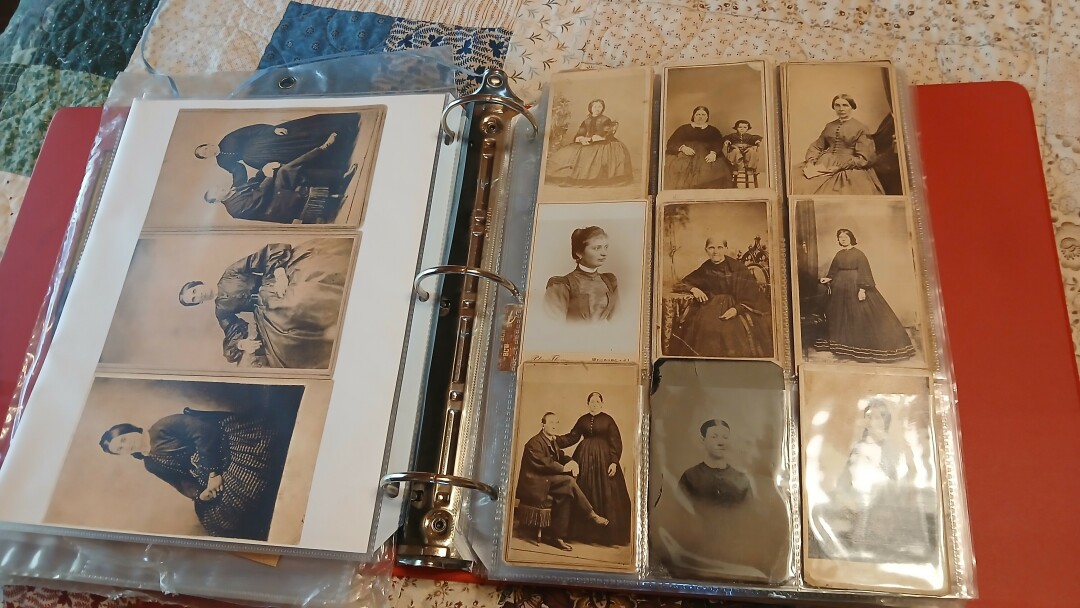
Sharon Durken collects daguerrotypes and tintypes and postcard photos of people whose images are long disconnected from their families – and their stories.
So Sharon imagines their stories and gives breath and dimension to their lives in her stories and poems.
“The pictures tell stories. Everything I have has a story,” she says.
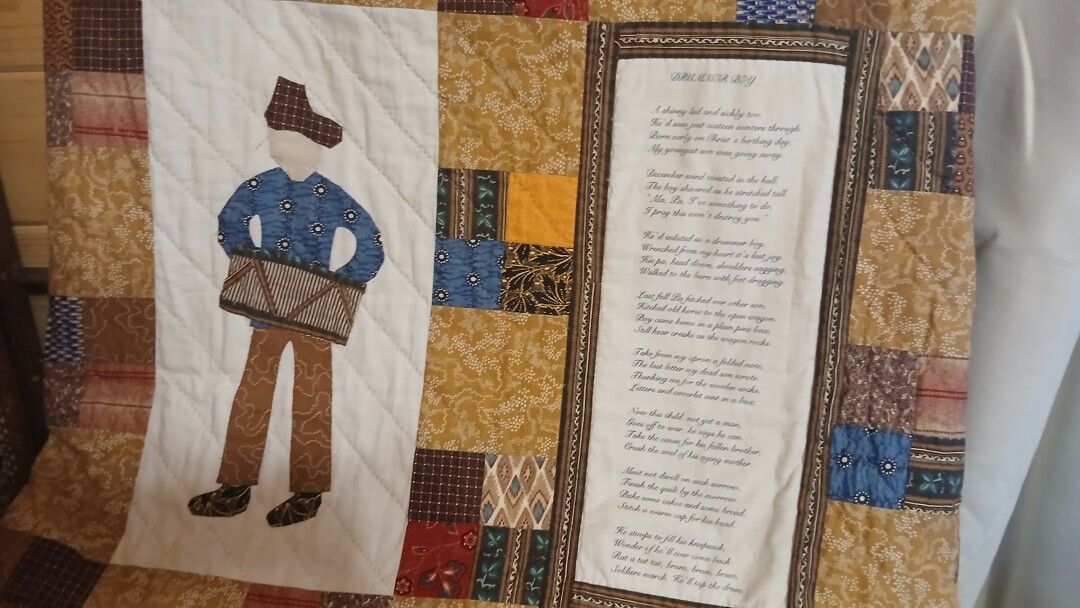
As she does with the found objects and the words that make their way into her quilts, Sharon looks to bring together the past – as disparate and misunderstood as it may be – into a meaningful present.
“We are products of what came before us. I hold a deep appreciation for the lessons of the past that are delivered to us in books, videos, photographs, and art work,” she shares and continues, “Antiques [also] play a role that inspires me. I’m always working on stories like Curse of the Belfry [one of her works-in-progress], “Growing up Kinship,” (my story about being raised by my aunt and uncle), Into the Boards, and Sent a Quilt, (Civil War poems I’ve written with Civil War-era photographs and quilts). I’ve been collecting old tintype and daguerreotype photographs for many years. When I look into their eyes it seems they are asking me to tell their stories, as I imagine them.”
This penchant and talent has helped Sharon, whom I’ve had the delight and honor to know for years as a writer, explore characters and worlds that span time and space.
“I fictionalize the experiences characters encounter, like in Kansas Prairie Promises [her novel] when the character Rebecca, Lucinda’s new stepmother, arrives from the East to live in the sod-house with her new husband and his family. This is a scene that still makes me chuckle each time I read it.”
Though she has traveled extensively, Sharon’s story begins in the Upper Midwest.
“I grew up on a farm that belonged to the Durkens since the 1800s. I still have some treasures in my home today. I share stories with my two sons about some of the objects, like the lovely ruffled green bowl that Uncle Henry (1895-1975) brought home from a neighbor’s house. It was used to feed the chickens. He admired it, they gave it to him and he brought it home for his mother, my grandmother,” she says.
On the Minnesota homestead she was raised on in the 1940s and ’50s, Sharon has fond memories of books and story time at home.
“I always looked forward to story time,” she says and notes, “My favorite book was The Three Little Kittens. I still remember Aunt Helen’s lap was warm, and I was sleepy but begged her, ‘Read it again.’ Another night I might choose Winken, Blinken and Nod for my bedtime read. As my taste became more sophisticated I loved The Owl and the Pussycat. The rhyme seemed to rock along with their boat.”
Rhyme, and poetry in general, made a profound impression on Sharon as a young girl, a student and an emerging writer: “The majority of the poems I write rhyme. I like the rhythm of the way the lines flow. The non-rhyming poems I first see in my mind as symbols, scenes, colors or emotions that I try to express through the words.”
But Sharon also found some of her literary beginnings in the (nearly lost) art of letter writing: “When I was young folks exchanged letters. When Aunt Helen wrote to her sister Rose, who taught in Michigan, I would add my scribble at the end. Once I could write, I corresponded regularly with friends and relatives via letters,” she remembers.
It was not only the sound of language that drew Sharon in, but also the stories themselves, the stories she heard shared around family gatherings: “I could never hear enough stories about ‘the old days.’ I wanted to know about my grandparents and their lives in Germany before they came to America. I asked to hear stories about the past and hair styles, clothes, early cars, and what it was like when they went to school with horse and wagon. I asked for stories that would explain wars in which my uncles and later cousins participated. One of my favorite stories was hearing about the first airplane that landed in a field near our town, Glencoe, Minn. It was the first airplane they had seen and were excited retelling the story.”
As a hungry and attentive listener and reader, stories began to take shape in Sharon’s imagination, even as a young child.
“I wrote a story in fourth grade titled, 'Pebble.’ The nun gave me an ‘excellent’ and a gold star. The story, and the joy of sharing it, are fond and proud memories. I now realize it was my story. Pebble was in a big lake pushed by waves and tumbled across the shore until a little girl picked it up and gave Pebble a home on her window sill in the sunshine,” she remembers.
As she grew up and on and pursued higher education degrees, Sharon sought out the novels and nonfiction books that would come to influence her writing, works like Bury My Heart at Wounded Knee and Wondrous and Times on the Frontier (both by Dee Brown).
“I appreciate Brown’s writing as he and other writers of history help my research when writing historical fiction,” she says.
Sharon also notes the important role museums have played in helping her find her next read and her next source of inspiration: “The museums I’ve visited offer delicious books such as Women of the West, Women’s War in the South, Women in the Civil War, The Female Frontier, Life of a Slave Girl, Sod Walls and many, many more.”
Sharon’s collegiate and professional life leaned into education and drama. She received an undergraduate degree in speech (minoring in drama) and then she went on to pursue, and achieve, her Masters of Science degree in Adult Continuing Vocational Education.
Professionally, Sharon channeled her creativity into her fourth grade and creative drama classes. Later, as an actor-educator, Sharon worked with the Climb Theater Company in St. Paul. But the stories (and her writing) continue to call to her.
Married to the military, Sharon found herself traveling and on the move (Minnesota, Kansas, California, Texas and Germany). The travel opened her up to other stories and geographies, and this fueled her imagination even more.
Wherever she went, the writing remained a constant, as did her interest in writing in different genres.
“I was president of the High Desert Chapter of the California Writers Club years ago, and we came out with an anthology. I was also taking classes at Barstow Community College in California, and they had a contest, and I won four first places with my writing [short stories and memoir].”
In addition to fiction, memoir and poetry, Sharon says she also writes letters to the editor and essays, and she shares that “It has always felt like the time to write.”
Always primed to expand and explore (and engage in more genre jumping), Sharon is looking forward to finishing a few works-in-progress and getting more of her work out and published.
“I’d like to finish things. When I finish writing a book, it’s like Ah, I did it. It’s a good feeling,” she says.
And she is now venturing into new territory: creating an exhibition of the quilts and photographs and stories that have inspired her displayed alongside her writing. She has begun the process of creating a multimedia display and is looking for a museum or other cultural space to partner with.
“I have the quilts. I have the photographs. I have the poems,” and she has the insight and spirit to create an exhibit that reflects on the nexus behind the stories behind each, no matter the genre or time.
Whether she is writing a novel or a poem or creating a quilt or listening to the unspoken stories of old photographers, Sharon sees her work as an opportunity for emotional and historical transcendence: “I hope my writing touches emotions, memories, and an appreciation for byegone eras and those who struggled to build the future.”
And for the other writers who may also be dealing with the “challenges that abound” (time, commitment, motivation, etc.), Sharon offers some cogent advice: “Just write. Everyone has unique stories, outlooks and experiences to share. Just do it. I find writing groups and classes immensely helpful. Once we’re gone, so are our stories. Writing has taught me something about myself. I stumble and ramble and don’t find the words I want to say when I dictate to my computer, but my fingers type the words before I know what I’m going to say or what the characters will do or say.”
Sharon’s novels are available at Foxes and Fireflies Booksellers in Superior, Spinster Books in Ashland and on Amazon.
| Tweet |