




News & Articles
Browse all content by date.

An American bittern stands quietly while getting ready to strike at prey. Photos by Emily Stone.
On a warm day at the end of June, the whole world buzzed with life.
Painted turtles slid off sunning logs as we paddled up the channel into Big Bay Lagoon on Madeline Island.
Song sparrows whistled and trilled their complex songs from the tops of scrubby black spruce trees. Through their trunks I spotted a veritable garden of pitcher plants blooming on a lawn of sphagnum moss. As we stepped carefully onto the warm wet sponge of the bog mat, a bumblebee hummed inside the nearest burgundy bloom.
Although it’s hard to walk fast on soggy sphagnum moss while not crushing the pitcher plants, I did my best to dart from one treasure to the next. Kevin followed behind at a more meditative pace, searching out the singers with his binoculars.
I barely caught the flash of brown out of the corner of my eye, but Kevin had a clear view. He followed the flight path of the bird until it landed on the far side of a small channel lined with arching sedges.
Despite the bird’s pinstriped camouflage blending seamlessly with the tall grass, and having never before seen one in the wild, his identification came instantly: American bittern!
These birds of mucky marshlands are hard to spot. It’s not just because of their cryptic coloration, but also because we’d sink into the mud of their damp, reedy habitats.
During my graduate school project monitoring wetlands in Maine, we spooked bitterns into flight many times while bushwhacking to our remote field sites. The kok-kok-kok call they made in agitation harmonized with the squishing of our boots.
Now a bittern was stalking along barely 20 feet away, and we could easily see the huge, bony yellow toes that kept it from sinking in.
As the heron clung to an insubstantial hummock of dried grass, its mottled brown rear wiggled in anticipation as the striped neck stretched forward. Then legs, feet and neck all uncoiled at once, launching the bittern’s spear-like beak into the water’s edge.
The white throat patch pulsed to gulp down the prey. Frog? Tadpole? Fish? Bug? We couldn’t see, and their diet is diverse.
As the bittern stalked a few steps forward to seek the next target, we stalked, too, creeping along our shore to keep it in view.
And although it peered intently into the water with yellow eyes shaded by a prominent brow ridge, it didn’t seem to notice (or care about) us.
It just continued its strategy: several quick steps forward to a new hummock.
Freeze.
Stare intently into the water.
Strike.
Gulp.
Repeat.
From the movement of its throat, we figured it had nearly perfect hunting success.
Although they are known to snatch dragonflies from flight, this one ignored the shimmering-winged insects darting above the grass. Perhaps it prefers easier and juicier prey. Like owls, they can regurgitate the indigestible bits.
For several minutes we watched in awe as the bittern worked its way down the shore. Then the walking on our side of the channel became too treacherous to navigate without long yellow toes and we turned back to explore the rest of the lagoon.
For the next several days we exclaimed about our good luck at having a front-row seat for such a rare show.
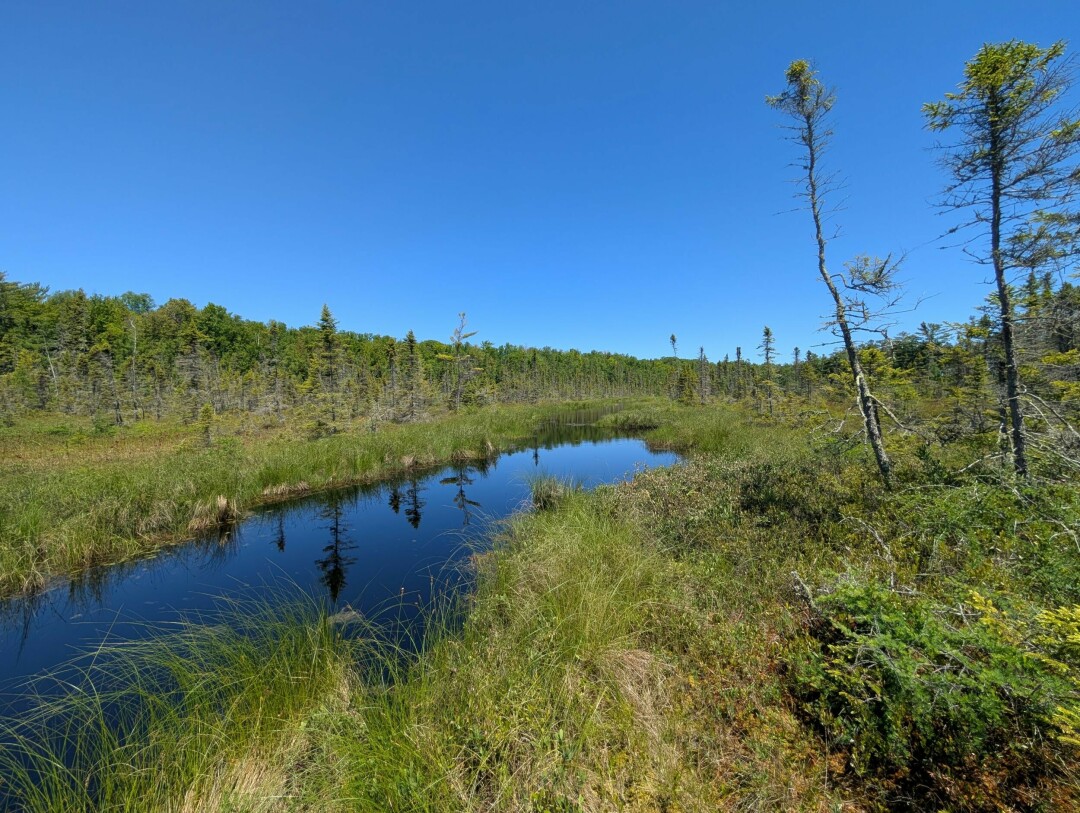
Protected wetlands like the Big Bay Lagoon on Madeline Island are essential habitat for bitterns and much more.
Bitterns hunt alone, mostly at dawn and dusk, and are said to be easier to hear than to see. Their deep booming, gulping calls travel far across marshes, but the male “thunder-pumpers” are vocal only during spring mating season, and so it’s not even that easy to hear them.
Add to that bitterns’ decline in parallel with the decline of their wetland homes, and we’d resigned ourselves to admiring their mystery instead of enjoying an encounter.
Perhaps we were too pessimistic. In the past several years I’ve spotted bitterns a few times. One summer two juveniles watched me bike by from the mowed roadside, the remnants of downy baby feathers sticking out from their new brown coats. So ingrained is their instinct to hide by standing with the striped neck vertical and beak in the air, sometimes swaying gently like grass in the wind, that they will do this even when out in the open.
A couple years prior, I’d watched a juvenile with the same telltale halo of down stalk insects in a short-cropped field on my way to pick blueberries.
Protected wetlands like Big Bay Lagoon are essential to American bitterns’ continued existence, as are similar habitats on their wintering grounds farther south. Protected wetlands are great for paddlers, too.
After we left the bittern, we stalked feasts of wonder in the form of hot pink orchids, a giant snapping turtle, darting fish, a family of loons and a world buzzing with life.
Emily Stone is Naturalist/Education Director at the Cable Natural History Museum. Her brand-new third book, Natural Connections3: A Web Endlessly Woven, is available to purchase at cablemuseum.org/books and at your local independent bookstore, too.
For more than 50 years, the Cable Natural History Museum has served to connect you to the Northwoods. Our Summer Calendar is open for registration! The Museum’s new exhibit, The Wetland Way is now open! Discover how life thrives at the intersection of soil and water, and why we must care for these special places as they care for us. Follow us on Facebook, Instagram, YouTube, and cablemuseum.org to see what we are up to.

| Tweet |