




News & Articles
Browse all content by date.
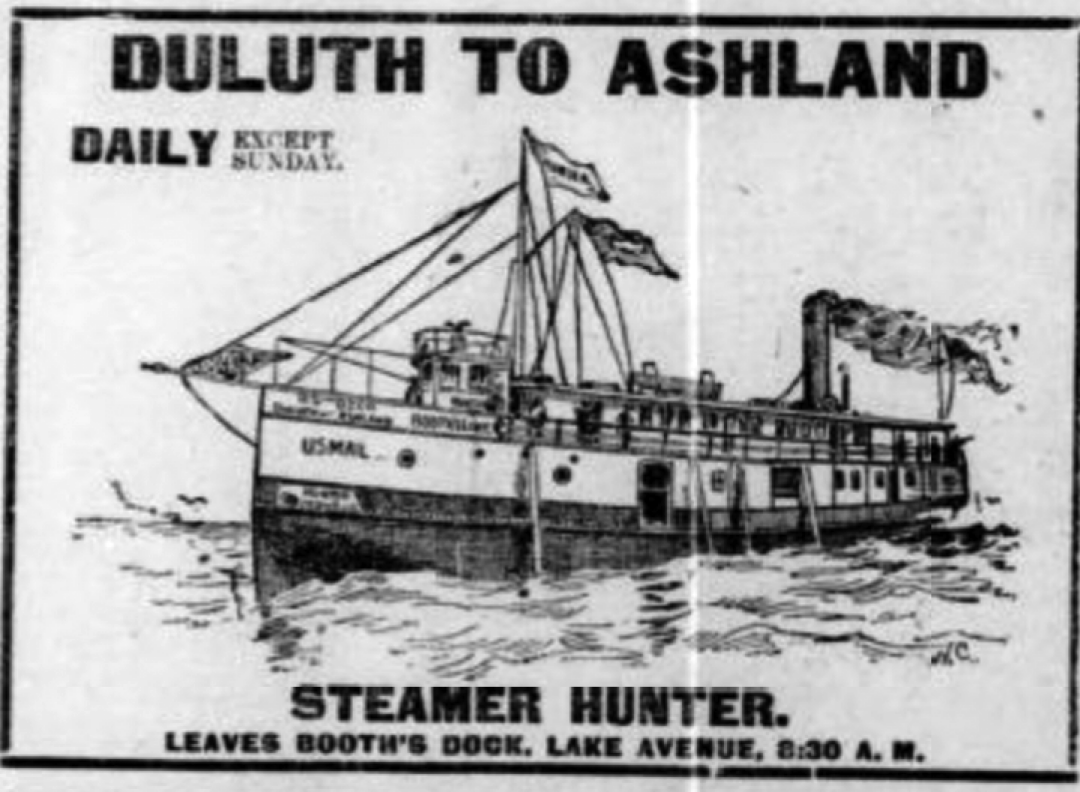 Duluth Herald, July 10, 1896.
Duluth Herald
July 9, 1889
NOW COME THE BURIALS.
Inquests on the Bodies of the Dead Rioters Are Postponed.
Wolf & Truax resumed work on their street contract at Tenth avenue west this morning. They have about thirty men at work and five times that number applied for situations. When the men began work several groups of known agitators passed by, but made no demonstration whatever. Yesterday afternoon word came from West Superior that 150 Italians were ready to make a descent on the city as soon as riot began again. There are several suspects under surveillance who are known to have uttered threats of destroying property.
At ten this morning two prisoners were brought down from St. Marys hospital and lodged in jail. One of these men was the one who fired five shots at Officers McLaughlin and Smollett, the other is known to have taken a leading part in the riot and shooting. The police, militia and citizens corps are still under arms. The weapons the former now have are guaranteed to plunge a bullet one foot into solid pine. The Grand Army of the Republic veterans have sent word to the authorities that they are ready to take part in any fight that may come up.
The violent action of the mob on Saturday has had a salutary effect on the city council. The city will see that the police department is fully equipped to meet any future disturbance. The patrol system will be established at once, latest improved firearms will be procured for the officers, and everything done to make this branch of municipal service secure against any outbreak that the coming years may bring. The officers will also probably undergo a course of military training, and regular drills will be had to make the men proficient in the manual of arms and march.
 Duluth Herald, July 18, 1966
Duluth Herald
July 10, 1896
TO BUILD
American Steel Barge Company Will Construct Two Great Carriers.
New Dry Dock, Larger Than
the Present One, Will Be Built.
President Colgate Hoyt Made
the Announcement in Superior Today.
Colgate Hoyt, president of the American Steel Barge company, is in Superior today, and he announced that his company is to make things move at a lively rate in a short time. To begin with, it is to build two new whalebacks for the company’s own fleet, both of them to be larger than the John Ericcson. The plans for these boats are not yet completed, but as the Ericcson is 404 feet long they will be larger than that. Capt. McDougall says that they will be the greatest cargo carriers ever built on the American continent.
The company will also build a new dry dock at Superior. This has been in prospect for a long time, and the need of it has been very pressing for the past two seasons. The new dock will be larger than the old one, and that is all the company has to say about it so far.
The old dock is kept pretty busy, and during a greater part of the time it has more than it can attend to, and the new dock, with its larger and better facilities, will be greatly appreciated by vessel interests.
The new whalebacks for the Bessemer fleet, the steamer John Ericcson and consort, will be launched at the barge works tomorrow afternoon.
 Duluth Herald, July 18, 1966
Duluth Herald
July 11, 1906
CITY STARTS
DAMAGE SUIT
Ringling Brothers Sued for
$1,000 for Injuring Pavement.
Claiming that Ringling Brothers’ circus has cut up and damaged a considerable extent of the new tar macadam pavement on West Superior street, between Thirteenth avenue west and Twenty-fifth avenue west, the City of Duluth has instituted a suit against the proprietors of the circus for $1,000 damages. The complaint, together with a writ of attachment on the big tent, was filed in the district court this morning by City Attorney Bert Fesler.
It is claimed by the county that the pavement was constructed to withstand all ordinary loads and traffic, but that the circus people drove over it with a large number of heavily loaded wagons with narrow tires. It is alleged that some of the loads were in excess of twenty tons.
The city alleges that there were at least two other thoroughfares by which the company could have reached the circus grounds and that Ringling Brothers were notified and that they had full knowledge of those routes, but that they carelessly, negligently and without regard to the notice, drove over and injured the tar macadam pavement.
 Duluth Herald, July 15, 1946
Duluth Herald
July 12, 1916
MERCEDES IS
DESTINATION
Minnesota Militia Believed to Be Headed for Border Point.
Duluth Boys Parade and Enjoy Swim
at Kansas City.
Spiro, Okla (Special to The Herald) – Third infantry boys from Northern Minnesota probably will be in action territory by Saturday.
Although regimental officers have carefully avoided all reference as to destination, indications are that the Third regiment will be sent to a border point almost directly south of San Antonio, Tex. Mercedes, a small post about twenty miles from Brownsville and thirty-eight miles from, the Gulf of Mexico, is the most likely point.
The Third Infantry special in three sections is being hurried through without delay. From Fort Snelling via the Chicago Great Western railway to Kansas City, Mo., and thence to Texarkana via the Kansas City Southern has been the route so far. At Kansas City the first and second section of the train met for the first time. Companies B, C and D of the First battalion visited the Kansas City ,municipal baths, while Company A marched through the streets and sang their songs to the Missourians. The first section is the only one of the three which has been established on trains and meals are above army standard despite some difficulties.
 Duluth Herald, July 11, 1906
Duluth Herald
July 13, 1926
HIGHWAY NO. 1
WILL REOPEN TO
TRAFFIC OCT. 15
Paving Work Progressing Between Duluth and Twin Cities.
Thirty-One Mile Stretch Will Remain Unpaved Until Next Year.
Paving work on State Highway No. 1 between Duluth and the Twin Cities is progressing rapidly and the entire stretch with the exception of thirty-one miles from Rock Creek to Wyoming will be paved and opened to traffic by Oc. 15, according to C. H. Dunning, chairman of the good roads committee of the Chamber of Commerce, who completed a tour of the highway with C. M. Babcock, state highway commissioner.
Mr. Dunning, accompanied by P. L. Mold, division engineer for the highway department, left Saturday for a complete tour of the road between Duluth and the Twin Cities. They were met by Commissioner Babcock at Carlton and together inspected each paving job down the line. Mr. Dunning and Mr. Mold returned yesterday, while Commissioner Babcock went on to St. Paul.
By Aug. 15 traffic will be able to go through Mission Creek nearly all the way on pavement, with the exception of two short detours in Carlton county. This will take the motorist across on No. 23, a state road, to Mora and south on No. 5 to Minneapolis. This route, totaling 186 miles, including 75 miles of pavement, 20 miles of detour in Carlton county on fair to good roads and 91 miles of state graveled highway.
 Duluth Herald, July 11, 1906
Duluth Herald
July 14, 1936
DULUTH’S HEAT WAVE CLAIMS
TWO MORE LIVES
Cool Lake Breeze Fans City,
Sends Mercury Plunging
Two more Duluthians were found dead this morning as a result of the heat. Meantime, a 25-mile northeast wind swept over the city early this morning and sent the mercury downward sharply until it reached 69 deg., a drop of 37 deg. In the last 24 hours.
William McQueen, 94, was found in his room at 114 West Third street, while James McDonald, a pensioned D. M. & N. railway employee, was found in his room at 251 South First avenue east by John Kerns, proprietor of the lodging house. Dr. C. F. McComb, county coroner, pronounced both deaths due to the heat.
Last night Thomas Doody, 83, 24 East Second street, was overcome and died in St. Mary’s hospital shortly afterwards.
The northeast wind brought real relief to Duluthians who have been suffering from the abnormal heat during the last week. The strong wind was responsible for the decided shift in temperature readings, the mercury dropping rapidly after sunup to 73 at 7 a.m. and continued to fall during the morning as the wind increased.
The weather man found the temperature mean for the last seven days was 84.8, the mark being brought high above normal by the 106.2 record set yesterday. The normal for the seven days is 63.6, showing an increase of more than 21 degrees.
 Duluth Herald, July 12, 1916
Duluth Herald
July 15, 1946
Patrick Overcoat Plant Production Begins in Duluth
New Firm to Employ 20 to 25 at Outset
Rebirth of an industry was recorded in Duluth today as workmen and machinery begin production of woolen overcoats at the plant of the newly formed Patrick Overcoat Co., at 326 West Michigan street.
The firm, licensed to use the nationally known Patrick label, will revive manufacture of men’s woolen overcoats here for the first time since 1929, when the former Patrick-Duluth Co. went out of business, it was announced by S. F. Atkins, treasurer.
He said business volume of the company is expected to be about $400,000 annually. A total of 20,000 coats is scheduled to be produced yearly.
Cost of equipping the plant has totaled $15,000, Mr. Atkins explained. A similar amount has been expended for materials with which to begin production of overcoats.
The company is headed by L. E. Sundby, Duluth, president. Ben Feldman, Minneapolis, vice president and general manager, has been in the overcoat business all his life in the Twin Cities.
Other officers are A. B. Anderson, secretary; A. A. Walker, assistant secretary-treasurer, and W. A. Peterson, superintendent, all of Duluth. Mr. Peterson was production manager and designer for the former Patrick Duluth Co. the board of directors consists of R. D. Alworth, Duluth, and officers of the company.
The firm will employ between 20 and 25 persons at the outset, increasing the personnel as production expands. Additional equipment is scheduled to be added. Space for the plant is leased form the Duluth Plumbing Supply Co.
 Duluth Herald, July 16, 1956
Duluth Herald
July 16, 1956
Woodsman Designs Violins
VIRGINIA – From a backwoods cabin in northern Minnesota’s brush country, bits of music fall occasionally on a small audience of birds and wild animals – John Koski’s only audience.
Inside the two-room log dwelling, a “shacker” of Finnish extraction, plys the delicate art of violin-making.
This former logger, carpenter’s helper and farm hand is living out his otherwise uneventful life in a way that combines the crude with the exacting, the simple with the sublime.
Koski, now 60, explains away the many years spent in fashioning violins with the phrase: “It’s fun to experiment.”
In one corner of his cabin lies a pile of slab wood chopped from Koski’s 40-acre tract. Elsewhere hang about 75 violins, some gathering dust, others drying.
From raw wood, the shy, recluse carves, chisels and fashions the many intricate parts that eventually make up the instruments which Koski doesn’t seem to care whether he sells or not.
Starting at will from tradition, Koski experiments with various woods for his violins. He shrugs off requests to use ebony for the fingerboard, bridge and pegs, saying, “If my violins are not marketable as they are, then let them remain that way.”
Not only are his materials crude, however. Many of his tools also have been fashioned from wood at hand.
Koski made what he calls “thickness auge” from wood and he fashioned several tiny wood planes from rounded birch roots and small metal blades. Homemade clamps hold glued parts of the violins together for drying, and his stains and varnishes are compounded in the cabin from gums and resins.
Koski’s craft began 50 years after he read a music magazine article on violin making. Still a subscriber, Koski keeps with the world of music through reading.
While he can play the violin after a fashion, Koski says he doesn’t make the violins to play or sell. He makes them just to be making violins.
 Duluth Herald, July 11, 1906
Duluth Herald
July 18, 1966
Bolts Hit Homes, Wind Fells Trees
Two homes were set afire by lightning, the roof of Rudolph’s Furniture City was caved in by the weight of water and other property damage resulted from a rain and electrical storm that struck the Twin Ports shortly after midnight Sunday.
Large numbers of trees were blown down by the strong winds, which reached a velocity of 46 miles an hour.
Electric and telephone service was knocked out in scattered areas in Duluth and the surrounding region.
Radio station WDSM was knocked off the air when high winds damaged its transmitter tower near Oliver. The station was still off the air this morning.
The home of C. W. Piering, 4820 Pitt St., was struck by lightning at 1:01 a.m. The resulting fire did about $2,500 damage to the house and $500 to contents, firemen said.
Another bolt struck the L. W. Sanford residence at 17 S. 28th Ave. E., starting a fire. Firemen estimated damage to the house at $2,000 and to the contents, $500.
The roof of Rudolph’s store, 120 W. 2nd St., collapsed under the weight of water from the storm and flooded the building with nearly a foot of water. Carpeting and furniture suffered principal damage. Leonard Rudolph, vice president of the firm, said amount of damage has not been determined.
Water also ran into the Davidson Printing Co. quarters and shut down production for a short while.
The Minnesota Power & Light Co. reported outages, mostly in West Duluth, caused by trees falling over 4,000-volt distribution lines.
The Superior Water, Light & Power Co. also reported damage to installations including those serving waterfront industries. The waterfront industries were left without power from 12:35 to 1:07 as a result of lightning damage to a line near the Thompson dam.
The U.S. Weather Bureau said a total of 1.84 inches of rain was recorded at the airport weather station and 1.92 inches at the harbor station.

| Tweet |